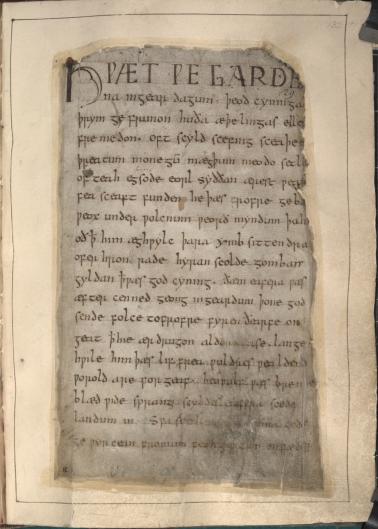
Beowulf
Beowulf is contained in the Cotton Vitellius A. xv. It is possibly the oldest surviving poem in Old English. It was written between the 7th to the 10th century and is an example of a work written in the West Saxon dialect which covers the West Midlands of England. The narrative is divided into three main sections: the fight in Heorot between Beowulf and Grendel, Beowulf's hunt for and duel with Grendel's mother and the battle between Beowulf and the dragon.
The PDF file below is my free-verse translation which stresses the words which make the West Midlands dialect, more specifically the Black Country dialect, sound so unique.

|
Beowulf.pdf Size : 1588.681 Kb Type : pdf |
Beowulf
Translated by
Kit O’Saoraidhe
Set to the dialect of my people
In this year of our saviour.
I live with love, with light, with peace *
I set about this translation after reading about the Old
English roots of this epic poem. Written in what would
become our English Midlands, many of its words and
idioms can be heard stil in the dialect of the Black
Country, to the west of Birmingham. In this
translation, I have endeavoured to catch the rhythms of
that dialect as wel as using words which betray the
character of the dialect. It is meant, therefore, to be
read out loud.
Dedicated to Jonnie Enright, who gave me a
voice.
* See appendix
Prologue
Hear me well! I speak of Warrior-Danes in days long past,
Of Clans and their Kings who performed great deeds
With courage in their Royal conquests.
I'll tell of Scyld, Scef's most brave Son, scourge of the enemy,
He seized his foe's great banqueting halls, rioting as he went.
At first he was lowly and destitute, but he rose in glory,
Proving his power as he swung his mighty sword
Until he stood above the widespread warring clans,
Beyond the whale-road, smiting all before him.
His enemies were forced to kneel down to him,
Such was his magnificence as a King.
In time an heir was born to Scyld, a young princeling
Whom God had sent to comfort the people.
He had seen the dreadful distress
They suffered before; long a nation without a leader.
So God Almighty made him a man of high renown:
Beow was this boy, his name spread
With his fame throughout the North.
Such a lad must become wise very quickly,
Giving of himself fully while his father-king lives.
He must grow strong and become a warrior,
So that through valour he can rally steadfast lieutenants
And hold the line in times of battle. This is the cast of a leader
Which makes the people look on in awe and wonder.
At the destined time, Scyld departed while still prospering
And crossed over into the Lord Frea's hands.
His faithful cohorts carried him to the sea's surf,
As he himself had bid them
While he could yet wield the words.
They carried him out into the sea's wild churning,
That leader they revered and had ruled them long.
There in the harbour stood a ringed-prowed boat,
Icy and keen to sail, a warrior's ship, a hero's vessel.
They laid him down, their beloved King,
Generous giver of rings and treasure, in the heart of the ship,
And raised the mast. Much treasure there was,
From far-gone lands, ornate armour and steel.
I have never heard of a ship so bejewelled
With weapons of war, battle dress,
Cudgels and blades. The shining bounty was piled on his body;
The wealth of a nation readied for it's journey
On the power of the sea's salty foam.
In no less measure did they deck his body
With offerings, like those first ones did
Who had let him loose as a child.
They launched him out on the churning surf
And raised the standard of gold
High above his head. Then they let him drift
On wave and tide and gave him to the ocean.
But they were left with troubled hearts
And mourning minds. No-one can say for certain,
Neither lawyers nor heroes under heaven,
Who recovered that vessel.
I
In time, Beow the Scylding, beloved King of the people,
Kept the battlements safe a long time after his father
Departed this world. To him in turn was born
The high Half-Dane. He ruled long and lived old and battle-fierce.
To him was given four children,
Heorogar, Hrothgar and goodly Halga.
I have heard that Yrse was Onela's queen,
His only daughter, the War-Scylding's devoted lover.
So it was to Hrothgar success and honour in war craft was given,
And his people remained loyal and steadfast.
His war-band grew into a mighty battalion. His mind turned
To building a great hall and mead-house, to be hewn by strong men
Which the world would hear of forever.
From within its walls he would share
His God-given prizes with all his subjects, both young and old,
But not the common land or his people's mortal souls.
Then I heard that from over the far and wide Earth,
Work was commissioned from many skilful craftsmen
To adorn this hall of the people.
In good time the work was completed;
It was furnished richly, the greatest of Royal halls.
Heorot was the name he gave it,
He whose words carried dreadful weight in all places.
He had no need to lie about the riches he owned and rings he dealt out
From the table at the feast. The hall rose high,
Towering loftily and horn-gabled,
Awaiting a savage burning by hateful flames. But the time wasn't yet nigh
For that furious edge-malice; a murderous spree
Unchained among brethren arising from deadly enmity
Which would inevitably awaken in time.
Then the deadly spirit impatiently anticipating the dreary time,
He who dwelt in the shadows and heard every day
The noise of revelry in the gilded hall, made ready to unleashed his jealousy.
It heard the harmony of the harp
And the sweet song of the troubadours
Who sang of the origin of Man, narrated from afar.
Of how the Almighty had wrought the earth;
That fair, sublime field bounded by the sea.
Of how He had triumphantly set up the sun and moon,
Those two great luminaries for the benefit of all the earth's men.
Of how he had adorned the four corners of the world
With great trees with leaves and strong limbs. Life too He had formed
For each and every species which lives and moves.
So the great lord's men lived in joy and prospered
Until that fiend from Hell began to commit fierce atrocities against them.
This ghastly demon was named Grendel;
Infamous stalker of the marshes, he who held the moors and fens;
The land of the marsh-monsters, in a desolate stronghold.
This wretched creature had ruled for a time
Until the Creator had condemned him
With the kith of Cain, whom God had outlawed
And condemned as a criminal for the slaying of Abel.
God had meted out terrible justice.
Cain couldn't profit from his awful crime
Because God had excommunicated him.
But from this curse there arose
Ogres and elves and spirits of the underworld,
Also giants who battled with God
For a long, long age until He gave them their dreadful dues.
II
When the night drew in, Grendel set forth
To the high house, to seek out the Ring-Danes
After their quaffing. He came upon that noble company,
Slumbering after the feast. They were fully sated
And impervious to pain and sorrow. Suddenly, the damned creature,
Grim and greedy, was ready and savage and cruel.
He grabbed thirty thanes from their rest. From thence he went,
Proud with his plunder, back to his lair,
Drunk on his bounty of the banquet of bodies, to seek his shelter.
Then in the half-light before the dawn,
Grendel's war-might was revealed to the men.
After their feasting they raised their lament
In a mournful morning cry. The mighty chief,
The prince, the old and good sat in sorrow.
The anguish of his loss oppressed him
And the great and mighty one suffered.
When they beheld the tracks of the wicked ghoul
Their strife was strong, loathsome and lingering.
Nor was it a long time, but a single night,
That Grendel returned. He perpetuated
A more brutal slaughter and it grieved him not.
He was fully entrenched in violence and viciousness.
The men shifted themselves to a safer place,
Further away to seek rest;
A bed among the bowers.
When the truth was made clear to him,
Truly told by an unmistakable token
Of the enmity of the hall's occupier, he held himself then
Further away. Whoever was able to flee
Kept a close watch and moved on.
So Grendel ruled and challenged the rule of law,
Pitted one against all until all the fine houses
Stood empty. For a long time;
In the space of twelve winters, the bitter anguish endured.
The Lord of the Scyldings laboured under sorrow and presently
It was known throughout the world in mournful elegies.
They were sung in laments about the besieged king;
The violent raids of Grendel against Hrothgar,
The long and protracted blood-lust,
Felony and feud sustained for many seasons,
Continual strife. He did not wish peace
With any man of Danish blood,
He did not work to desist in furious fellow-slaughter,
Or to pay the price of the trade in death.
None of the counsellors could ever wish
For deliverance from the slayers' hands.
But Grendel was persecuting warriors both old and young,
He hunted them in the dark-death-shade,
He set snares and lay in wait. In the perpetual night
On misty moors, men couldn't know
From whence such hellish hauntings would slink from their dens.
Thus many humiliations Grendel committed;
That terrible lone traveller, that foe of man-kind.
He made his dwelling in Heorot,
In the richly upholstered hall through the blackened nights.
His was not the throne-stone,
Yet he was marked to approach it respectfully;
This treasure, the gift of the Gods. Neither did he love it.
That was a great misery for the Scylding's kin,
It broke their spirit. Often the king sat,
Mighty at the counsel, pondering on a plan
To wage war against the sudden horror.
Oftimes they pledged at holy temples
Sacred prayers that a slayer would offer succour
From the plight of the people. Such was their intercession,
The hope of the hoards. They pondered on hell
In the depths of their hearts. They knew not the Creator of the earth;
The high Judge. They were no longer aware of God,
Nor yet could they honour the Helm of the Heavens.
Woe be to him who in times of trouble must thrust his soul
Into the fire's embrace, for in that embrace there is no hope of relief,
Or any change at all. But blessed is he
Who after his passing can seek the Lord,
And so in his Father's arms, keen towards Heaven.
III
So then over the sorrow of the age, the Son of the Half-Dane
Continuingly brooded. The wise hero could not
Turn away from woe. The strife was strong,
Knawing and enduring. Upon the people came
The deepest fear, violence and trouble.
Hygelac's thane, a good man of the Geats
Heard at home of Grendel's deeds.
He was of man the strongest
Of his time, the most noble and mighty. He ordered a goodly boat
To be built and prepared it to sail. He declared his plan
To sail over the swan-road. He wished to find
The mighty clan-chief, since he was in need of good men
To embark on a crusade. No one tried to hinder him,
No elder denied him; They followed the omens
And urged on the valiant-hearted Son.
This worthy man chose champions for the Geatish people,
Those who were bold, the best he could find. Full-fifteen strong
They sought the strong ship and they boarded
The boat at the boundary of the shore.
Time passed by, the boat was in the waves
Close to the cliffs. The war-ready warriors
Stepped up to the prow as the currents curled around
The sea and the sand. The men bore up
Into the heart of the vessel arms and armour,
Noble war-gear. Then they pushed out the boat
Away from the shore and welcomed the voyage in their strong ship.
They crossed over the waves, urged on by the wind,
Cutting through the foam like a soaring bird
Until the due time, on the second day,
When her curved-prow had made light of the journey
So that the sailors sighted land,
Bright sea-cliffs and towering shores,
Wide headlands at last greeted their quest's end.
So their voyage was over.
Without pause the Wederas-warriors disembarked,
And moored their vessel. Their chain-mail clashed,
Their weapons were dropped on the shore. They thanked God
That the journey had been smooth.
Then from the look-out the Scylding,
He who had the duty of guarding the sea-cliffs,
Saw bright-bossed shields and eager weapons
Borne over the gang-plank. Curiosity overcame him,
He wondered who these men might be.
He mounted his horse and rode to the shore,
This horseman of Hrothgar and vehemently shook
His wooden staff and asked:
'Who are you, soldiers, armour-wearers,
Bound in bymies. For what reason does your tall keel come?
From where do you sail over the sea-street
Hither in the waters?'
He was the coast-guard, he had the sea-watch
In order to ensure that no invasion onto Danish land
Would be able to disembark on the shore.
'Never before have shield-bearers landed
On our shores, not stopping to ask fair passage
From our clan. You do not have our kinsmen's consent.
But never have I seen a more noble form on earth
Than you in your bright armour standing before me.
You are truly noble. But I must know from whence you came,
You aliens from another land come to the home of the Danes,
Now you travellers from far away tell me!
So I can report it - from whence have you come!'
IV
The elder watchman answered, the crew's captain
And unlocked his word-hoard:
'We are of the Geat tribe
And Hygelac's hearth-companions,
My father was a famous man,
A noble vanguard-warrior named Edgetheow
Who had seen many winters before he passed away.
To our courts he was recalled often and will be remembered well.
We have resolved to come in peace to find your lord,
The Son of the Half-Dane, the protector of the people.
Be a trustworthy guide to us, we have a great mission
For the Danish lord, We have no reason to ask in secret.
So tell us if it be true that amongst the Scyldings there is a threat,
Whatever it be, this danger at work in the night,
This unknown enmity causing suffering and slaughter
In the Scylding's lands. I have come to help
And in a spacious spirit offer my counsel.
I can show the wise Hrothgar how he can beat his enemy
And find comfort again, if any comfort can reach him.
I can offer relief from this suffering of miseries
And succour the hot wells of melancholy,
Or else hereafter he may endure a time of torment,
Hardship and woe and live in grief
As long as his house stands.'
Still sitting astride his horse the coast-guard answered;
'Every sharp shield-warrior must know the measure
Between words and works.
I hear you. I see you are a loyal legion
To the lord of the Scyldings, go forth
Bearing your shields and armour, I will guide you.
Likewise, I will order my kin-thanes
On their honour to keep your ship
Down there on the beach against any who may come;
Your vessel, newly tarred on the sand, until the time comes
For it to cleave the waves again
And bear this man back to Wedermark;
To him who performs noble deeds will be granted
His survival at the end of the battle
So they went on their way, the rested boat awaited
As it rode on the shore, the broad-bosomed ship
Secure on its anchor. Boar figures shone
Above their head-dresses, adorned with gold,
Glittering and fire-hardened, watching over them,
War-spirits raised. The men hastened,
Marching forward in step until they glimpsed
The timbered hall, glorious and gold-trimmed.
It was the most awe-inspiring (for earth-dwellers)
Of halls under the heavens. In it the ruler dwelt,
And its light glimmered over many lands.
Then their escort guided them into the court of great men
And ushered them on. Then this noble soldier
Kicked his horse to turn it and spoke:
'It is time for me to depart. May the all-ruling Father
With his grace protect you
And be with you in your sojourns!. I will go back to the sea
To keep watch for brutal invaders.'
V
The road was paved with stones and allowed them
To march in columns. Their chain-mail glistened
Harshly in the sunlight, ring-gloss glittering.
They sang as they went. They later arrived
At the hall in their grim apparel
And they set down their wide shields,
Their rims diamond-hard against the wall of the hall.
They sat wearily on the benches, their armour
Clanking as they went. They placed their spears,
Seamen's weapons, all together
Waxing silver above a grove of ash.
The iron army was honoured in the hall. Then a proud noble-man,
The most elite of the band, asked of the visitors;
'From whence do you hail with your plated shields
And steel-hued shirts of mail, masked helms
And your host of spears? I am Hrothgar's
Herald and chief-officer. I have never seen
This many men seeming so brave in spirit from a foreign land;
This band of brothers of valour, not exile,
So full of heart who have ever sought out Hrothgar.'
Then the most noted and courageous of them,
The proud prince of the Geats, answered with these terrible words;
'We are Hygelac's companions at table,
My name is BEOWULF.
I wish to proclaim to the Son of the Half-Dane,
That famed sovereign, the detail of my errand
To your virtuous lord. We hope he may grant us
An audience, and graciously allow me to greet him.'
Wulfgar then spoke, he was the Wendel's leader,
His courage was legendary,
As was his war-skill and wisdom. 'From you, the friend of the Dane's,
Lord of the Scyldings, I will take this message,
According to your will, to our fabled and noble King,
Our most respected Lord, the giver of rings.
I will go from hence and parley with him
About your dread mission, then hurry to see you again
With the answer it pleases him to give'.
He then turned post-haste to where Hrothgar sat,
Old and grey, amid his company of earls.
He strode out, distinguished and grand so that he came by the shoulders
Of the Dane's lord. He knew the customs of great warriors.
Wulfgar made his speech to his friend and lord,
'From over sea, far, far away, these men of the Geats
Have ventured to visit us.
The eldest of these elite band
Is called BEOWULF and they ask my good lord
That you may come and parley with them.
Give them not refusal, gracious Hrothgar,
They are dressed in their war-gear and seem worthy
To be called noble-men. Indeed, their prince is powerful
He that is borne hither by his warrior-band.'
VI
Hrothgar spoke, the protector of the Scyldings:
'I knew him as a youth,
His father was called Edgetheow.
Hrethel of the Geats gave him
His daughter in marriage. Now his heir
Has bravely come here seeking a steadfast ally.
Furthermore, it is said by sea-farers,
They who by our gifts of coins ferried for the Geats
Here in thanks, that he had the strength of thirty men
In the grip of his hand.
Holy God in his benevolence gave him renown in war
And has sent him to us,
To the West-Danes, to offer us hope
Against Grendel's terror! I must offer to this goodly man
Precious treasure for his great daring.
Order him in, with haste,
To see me and our noble band all together,
Say to them that they are most welcome
To the Danish lands.'
So it was announced at the door of the hall,
'I am commanded to say, my valorous lord,
The leader of the East-Danes,
That our leader knows your ancestry,
And that you are welcome here,
Mercifully delivered from the sea-swell.
You may enter the hall in your armour,
Under your visored helmets, to see Hrothgar,
But let your spears and shields be left here
Until we are clear of all suspicion.'
Then the mighty one and his many warriors drew themselves up;
That glorious band of thanes. Some waited behind,
Guarding the weapons of war as their leader had ordered.
They hurried together, their captain at the head,
Under Heorot's gabled roof.
So it came to pass that BEOWULF spoke,
Severe under his helmet, in the midst of the men in the hall,
'Greetings to you, Hrothgar, be whole and hearty.
I am Hygelac's kinsman.
I have undertaken great labours and campaigns
From my earliest youth.
Now news of Grendel's exploits have reached me at home,
It is said by sea-farers that you suffer in his grip.
We hear that this hall stands idle and useless
After twilight under the firmament of stars.
I have been advised by my kins-folk,
The best of men, to come to you, King Hrothgar.
So I have resolved to undertake this journey to your halls.
For they knew of my great strength
And had looked on in wonder when I returned from battle,
Stained with the blood of my enemies,
When I defeated five beasts,
Destroyed ogres and amid the waves of the sea
Slew sea-beasts by night.
I overcame distress when I was cornered,
I avenged the injury of the Geats - (they sought their own downfall),
And now against Grendel I am bound to battle,
That awful creature, to settle the score alone.
And so to my request, O Prince of the Bright-Danes,
Dearest deliverer of the Scyldings, friend of your kins-men,
And their noble defence, my only request,
Is that you don't refuse me, now that I have come from afar,
That I might alone with the company of nobles
And my hardy band of brothers, cleanse Heorot.
I have heard that Grendel, that evil creature,
In his recklessness has no weapons and scorns their use.
Therefore, to cement Hygelac's fame,
And to please his heart, I renounce the sword
And yellow-rimmed broad-shield so I may fight the fiend
Hand-to-hand; a life and death battle.
The outcome must be deemed the judgement of God,
If Grendel prevails, it shall be a terrible day,
And he will devour fearlessly,
As he has so before, the Geats in their halls.
You shall have no need of a shroud for my head,
For he will take it and have me fiercely stained in gore.
He will bear my bloody corpse and feed on it
Without mercy, in a terrible frenzy.
Nor shall you need to mourn or make funeral plans.
If I am taken in battle, send my breast-plate to Hygelac,
That Wayland wrought and Hrethel gave to me,
For Fate must proceed as Fate must.'
VII
Hrothgar, the helm of the Scyldings spoke:
'BEOWULF, you are fit for the fight, my friend,
And for honour you have sought us.
Your father began the greatest feud;
By his own hand he was Heatholaf's slayer
He of the Wylfings. Then his spear-kin,
For dread of reprisal, could not shelter him,
From thence he came over the welling of the waves
To seek the South-Danes.
At that time I had begun my rule over the Danish people
And in my youth held the precious kingdom;
The treasure-keep of heroes. Then my eldest brother died;
Heregar was his name, a better man than I,
Also the son of the Half-Dane.
The feud I settled with a ransom.
I sent to the Wylfings ancient treasures
Across the sea's swelling. Edgetheow swore oaths to me.
'It brings me sorrow to admit in my heart
To any man that Grendel has caused the humiliation
Of the people in Heorot, with his hatred
Carried out in blinding attacks.
My army waned, that fearsome war-band,
They were swept aside by Fate by horrid violence.
But God can readily put an end to rash ravagers’ deeds.
'Oft times, having got drunk on beer
Over their flagons, battle-men in the hall
Would await Grendel's terror with a vicious edge,
And pledge to protect Heorot.
But at the break of day, the floor of the mead-hall
Was smeared with blood and slaughter.
So they died, my faithful friends, and I had fewer allies.
But now, let us sit down at the feast and unchain our thoughts
And sing of your glorious victories with a hearty voice!'
Then the Geatish men gathered in the mead-hall,
Room was cleared on the benches
And the strong warrior-band sat down at the table,
Proud in their prowess. A thane performed his duty,
Pouring lashings of mead from an ornate vessel.
A bard sang, there was joy in the hall;
A great many men; the union of Danes and Geats.
VIII
Unferth, the son of Edhelaf spoke,
He who sat at the feet of the Lord of the Scyldings,
He had read the runes of the brave BEOWULF.
For him, this brave sea-farer's adventure
Was a source of great displeasure,
Because he did not grant that any other man on middle-earth
Should outdo his brave deeds and enjoy greater praise.
'Are you the same BEOWULF who fought against Breca
On the blue sea, in a race?
Where you for mere bravado tempted the cold waters
In a foolish boast in the open sea,
Risking your lives? Could no man,
Neither friend or foe,
Dissuade you from that foolish game?
Yes! You swam into the sea,
Tested the currents, your arms embracing the flood,
Inundated by the water's grasp in winter's swelling waves.
You toiled with him for seven nights before he got the better of you.
He was stronger than you. Then in the morning,
On Heatho-Ream's shore he was cast up by the sea.
From thence he travelled back to his homeland,
The land of the Brondings, dear to his people.
A fair city it is and his people lived in boroughs and rings.
So Breca's boast was proven to be true.
In this quest I expect worse results,
Though you have prevailed in your war-assaults thus far.
This time, in grim combat you will be vanquished
Within a single night against Grendel'.
BEOWULF, the son of Edgetheow replied:
'Hark! You have said a great deal about me and Breca,
Unferth, my friend. But you are too drunk on beer!
In truth I claim I have greater sea-strength,
Greater is my hardship on the waves
And I am a strong swimmer.
In our youth we would risk our lives on the ocean,
We carried drawn swords as we rowed on the sea-sound
Hard in our hands. Against the whales
We would defend ourselves. Breca was not a whit like I
On the sea-waves. I was swifter on water,
I could swim out further than he ever could.
We struggled, head to head
For a whole five nights, until the sea drove us apart.
The water welled up, it grew exceeding cold
And the nights were dark in the fierce northerly wind.
The waves were wild and high
And the whales wrath was aroused,
My chain-mail shirt, strong and hand-linked helped me,
My battle-garb lay on my breast
Adorned with gold. I was drawn to the bottom of the sea
By the hostile ocean monster. It held me fast,
Cruel in its grip. But I was granted a chance;
With the tip of my spear I reached out at the creature
And the battle was over. In the war-rush
I had destroyed the beast single-handedly.
IX
'Foul attackers sorely pressed me time and time again,
I swerved at them with my dearest sword
And I gave the battle my entire strength.
Those foul perpetrators did not have my flesh
Or rejoice in what they could take of me.
Neither could they feast on me at a banquet
In the sea's deepest parts.
Rather by morning, by many sword wounds
And all that was left by the waves,
They lay, put to sleep by my mighty spear.
From thence, sea-travellers could not be hindered
On the water-way. Light came from the east;
A bright beacon of God. The sea became still
So that I could see the headlands and the windswept cliffs.
For their deeds, Fate often spares
The immortal hero when his courage endures.
But it was lucky that I slew nine of the sea-monsters
With my bright sword. I have never heard by night-light
Of a more grievous fight under heaven's tree of stars.
Nor was a man so wretched in the waves.
Yet I had survived with my life,
Although I was weary from my toils. The sea bore me off,
Flood following the currents on to the land of the Lapps
In my tossing boat. Never have I heard told
Of such strife in conflict. Neither have I heard told
Of such sword-battle. Even Breca could never
Wield a sword so boldly in the fight!
Nor any of this company so boldly perform such brilliance
With bright swords. I do not boast, this is a fact!
But you killed your brother.
Though your mind is quick and strong,
You must in hell suffer torment.
I say in truth, son of Edgelaf,
Grendel would not have committed so many atrocities
If you were as brave as you profess to be,
Nor would humiliation be visited on Heorot if your heart
And your spirit were battle-fierce.
But he knows he need not fear the fight with you,
Your sword cannot hurt him and he has no fear of a counter-attack
From the Victory-Scyldings.
He knows he can force the battle and trample you Danes down.
He can carry on his torment on his own terms,
Slaying and dispatching at will. He does not expect a contest
From the Spear-Danes. But I will be different.
I will show to him the Geats' might and courage.
A man will be able to go back bravely to the mead, when the dawn comes,
The sun clad in radiance from the south.'
Then the battle-brave giver of gifts was joyful,
He with the wizened beard and hair.
The lord of the Bright-Danes heard in BEOWULF
Great fortitude of heart, a great guardian of the people.
There was great laughter among the men, noise became songs
Of joyful lyric. Wealhtheow came forward,
Hrothgar's queen, well-born with pure etiquette.
With her head adorned with gold she greeted the men in the hall
And then this fair lady gave out full cups,
First to Hrothgar, the homeland's brave guardian.
She bade him be generous in the partaking of the beer.
The great man, beloved of the people took in delight
The cup and the banquet.
Then she went among the men, the lady of the Helmings,
To young and old. A full draught she gave
To each in their cups until she came upon BEOWULF.
The queen, adorned with riches
And blossoming in spirit, carried a mead-cup.
Then she greeted the Geatish prince, thanked God
That a saviour had come among them
To ease their pains. He took the full-cup,
That slaughter-fierce warrior, from her.
Then spoke BEOWULF, the great Son of Edgetheow:
'I resolved that when I set off on my sea-journey
And sat down in the ship amid my company of warriors
That I would work for you all in full strength
Or fall in slaughter, fast in the enemies grip. I must undertake
This dangerous quest and prove my worth,
Or in this mead-hall, meet my death.'
The woman heard these words and liked them well,
This speech of BEOWULF the Geat.
Then this noble queen of the people,
Her jewels arrayed in the best gold,
Went to sit with her lord Hrothgar.
And so they were as before in the hall,
Bold words were spoken and they were full of joy,
Carousing around until presently
The Son of the Half-Dane wished to seek
His night's rest. He knew that a demon
Had plotted an attack on the hall
From when the sun's light first bathed the earth.
Shadow-shapes came slithering,
Black beneath the skies. The men all arose and took their leave.
Hrothgar bade BEOWULF good health and good luck,
Named him the ruler of the hall and spoke these words;
'From when I first could lift a shield,
I have never trusted or given control
Of this Dane's hall to anyone, save yourself.
Take it now and hold it truly, this best of halls.
Draw yourself up to glory, show great valour in the fight.
Keep diligent watch against the enemy.
There will be no limit to your desires
If you can break through this test and survive with your life.'
X
Then Hrothgar left with his band of brothers;
The protector of the Scyldings, out of the hall.
It was his endeavour to seek out Wealhtheow,
His queen and companion and lie with her. The Glory of Kings
(So men learned), had posted a guard with a special duty;
To watch for Grendel on behalf of the chief of the Danes.
The prince of the Geats placed trust
In his strength and his captain's favour.
Then he took from himself his iron breast-plate,
Removed his helmet and gave his adorned sword,
Wrought from the choicest of iron, to his attendant
And commanded him to guard his battle-gear.
Then BEOWULF announced before he stepped into bed,
This proud assertion:
'In martial mode, I am as dangerous as Grendel.
Therefore I shall not slay him with a sword
To deprive him of life, though, of course, I am fully able.
He knows not the finer points of battle, and although known
For malicious deeds and wild strength, no weapons
Shall be used. He shall face me unarmed,
If so he dares. And so may the wise God
Give victory to whomsoever He chooses,
And give glory to the same.'
Then the brave war-lord lay himself down
Along with his band of warrior-men and brave sea-farers.
Not one of them thought they would ever see their dear home-land again,
Or visit their kin-folk and the people that had raised them,
For they had heard that many Dane's in the mead-hall had already
Been carried off by Death. But to Wederas' men, the Lord had granted
The woven-destiny of strength in war
And solace and support. Through the might of one
Everyone would prevail in the battle.
This truth remains: that God has ruled
Over man-kind since the world's early dawn.
In the blackened night the shadow-wanderer crept in
While the sentries and arrow-men slept,
They that were obliged to guard the hall.
All but one, it was understood abroad
That while God heeded it not,
The monster could not bear them to his shadowy lair.
Yet this one man watched in angry agitation,
Ready to leap into violent action.
XI
Then from under the misty cliffs,
Grendel came stalking. God's wrath he bore
And the vile revenger aimed
To snare a man-morsel from the high hall.
He lumbered under the clouds until he saw the hall,
The gold-hall of men,
Shining bright in the light. It was not the first time
He had sought out Hrothgar's home,
In all the days of his life, he had encountered
Only hard luck in finding the hall-thanes.
But now he approached the mead-hall, grim in his purpose.
The door opened easily as he pushed with fire-forged hands.
With evil in mind, he tore the door open.
His rage was mightily sore as he crossed the threshold.
He then bore heavy on the chequered floor,
Advancing angrily. His eyes were of flame,
It distorted the air and he saw in hall the warriors gathered,
Sleeping in their company. In his heart he laughed.
Before the break of day, he vowed
To attack the men and suck the life from their bodies,
Now that he had come across this most full feast.
But it was not his fate to enjoy the murder,
His days of slaughter had come to an end.
The kinsmen of Hygelac, seeing how the cruel killer
Had formed the attack, now watched the beast closely.
Nor did the monster delay,
But at the first opportunity quickly grasped
A sleeping warrior who yielded without complaint.
Grendel bit into his bones and the blood ran thick,
And he swallowed great chunks. Soon he had the unfortunate man
All devoured, hands and feet.
Nearer he stalked towards the men.
Taking him with his hands, BEOWULF
From his slumber, reached for the vile creature,
He quickly grasped the foe in his palm
With malice in his heart and clamped down on his arm.
At once this shepherd of atrocities
Had never met such pain in the whole earth,
Even in the whole expanse of the world from another man.
As BEOWULF gripped tighter, Grendel began to fear for his life,
He couldn't get free too soon, eager was he
To end the mere thought of such a warrior. He wished to flee
Back to his lair, for he had never encountered
Such a savage attack in all his life.
BEOWULF then recalled his speech
To the brave men of Hygelac,
Upright he stood and took a firm hold.
His fingers cried out in pain,
The monster retreated as he was overpowered.
The vile monster was in need of escape,
In order to retire to his secret place in the fens.
BEOWULF loosened his grip, the monster had relief at last.
It was the most bitter sojourn he had taken to Heorot.
The noble hall broke into a roar. All the Danes
In their citadel stumbled due to the effects of bitter drink.
The two warring factions crashed loudly into the mead-hall.
There was great wonder that the hall withstood the violence.
But it was firm in foundation, inside and out
It was re-enforced with iron bands,
Skilfully smithed. I have heard it said
That from the floor broke away many mead-benches adorned with gold.
Until that day, it was thought by the Scyldings
That nothing, no man, could break up the hall and cleave it asunder,
Not even the fire's embrace could swallow it in the inferno. Then a wailing sound
Welled up from within and the North-Danes
Stood up in horror. Even the most stout-hearted felt fear
Because of that cursed scream.
For it was the howl of the vanquished, the lament of the loser.
BEOWULF held the monster fast,
He who of all men was the strongest
Throughout the days of his life.
XII
But the protector of the house had no wish
To release alive the murderous guest.
In all the days of his life he considered life to be
Of little account. The warriors of BEOWULF,
Time and again had defended their prince-lord's life,
If they had the ability or had been called to do so.
They were bold-minded battle-men, solid in action,
Striking out on every side, seeking the soul.
They had joined in the struggle,
With the choicest of iron without having known
That there was no blade in the black-smiths art
That could stop their opponent.
By the black arts Grendel had taken away the keen edge of the sword,
But the severing of his life was bound
To be wretched, and the alien-spirit
Would travel far away into the devil's possession.
Then he who had poured misery on men
And pain and affliction in times before;
Also, he who had fought with God
Found that his body-shell would not obey his will.
For the daring kinsmen of Hygelac
Held him in their hands, each of them loathed the other
For as long as either lived.
The monster's pain was great and a wound appeared
So that his sinews had sprung asunder
And his bones were broken. BEOWULF was granted
The war-glory; Grendel was driven, sick to death,
Back to seek his joyless lair. He knew that surely
His life would soon come to an end.
After that slaughter-storm, all the Danes knew
That one crimson clash had fulfilled their hopes.
The man who had come from afar,
BEOWULF, the strong and shrewd, had rescued the hall of Hrothgar.
He was happy with the courage he had displayed in his night's work.
To the East-Danes the Geats' leader had fulfilled his oath;
They that in anguish and grievous sorrow well endured,
And with no small misery, had been delivered. There was a clear sign
In the hands of the hero; high under the gaping roof,
The whole of Grendel's arm and shoulder
Was gripped in his magnificent grasp.
XIII
And so morning bled into the night, and many warriors assembled,
As I have heard, around in the gift-hall.
Clan leaders arrived from far and near,
From a wide compass to behold the wonder
Of the monster's footprint. His parting from them
Made no man mourn among those who had seen the foe;
How he had wearily been ejected, doomed and driven back,
Leaving behind only bloody smears, the water seething
With terrible swells, all mingled with boiling gore.
Doomed to die, he had himself then, bereft of all joy,
Retreated to his fen-refuge. This heathen soul
There laid down his life and Hell embraced him.
From thence the old companions,
With many young men in their wake, sated by the chase,
Rode on their horses in hearty spirits.
The legend of BEOWULF and the glory of his doings
Was widely praised. Many men often said
That neither south nor north between the wide stretch of the sea,
Even over the whole vast earth, that there was no better shield-bearer
Of a more worthy kingdom.
Nor did anyone put blame on the great and gracious Hrothgar,
For he was a good king.
At times the brave warrior-hoard let their horses leap
In races wherever the ground allowed it.
At times the King's thane, a man laden in fine speech
Remembered old songs. He knew of many ancient traditions
And recalled their lyrics and found new words,
Bound in truth. The man then began
To weave new words to old tunes, telling of BEOWULF's
Campaigns and victories in skilful recitations,
Artfully uttering adept tales.
He told of what he had heard
Of Sigmund's glory, of deeds beyond belief
By Wael's son, his great odysseys,
Things of which the people by no means knew of before;
Feuds and feats and triumphs of war,
Except Fitela, he of such matters wouldn't speak,
Uncle to nephew as they always were,
Comrades in arms in every conflict.
They conquered giants with their flashing swords
And brought them down.
For after the day of his death, Sigmund arose;
A man of no little fame
Since that fierce warrior had quelled the great serpent,
The keeper of the treasure-hoard, beneath the hoary grey stone.
He, the prince's son, ventured out alone
On his dangerous deed. Fitela was not with him.
However, it was granted that his sword
Pierced the dreadful dragon, so that it stood pinned on the wall
With noble iron. The dragon perished,
That fearsome worm. It had ensured that through courage,
The ring-hoard he might possess
And do with it what he would wish. Wael's son loaded his ship,
The bowels of it he filled with the gleaming treasure.
The dread worm melted away.
Sigmund's adventures were feted everywhere
Among the nations. A warrior's protector,
He had prospered well through deeds of great valour
Since Heremond's skirmishing had ended,
And his power diminished. Among the Etins
He had been given up to the enemy's hands
And quickly dispatched. The surge of his sorrow
Stayed with him for many a season. To his kin-folk he became
A noble of great mortal sorrow.
Moreover, they often lamented in early times
The departure of their stout-hearted king. Learned magi
Had trusted to him a remedy from their misery;
That the prince's son must prosper,
Take up his father's lead, rule the people well
And protect the treasury and castle; the heroes' kingdom,
The homelands of the Scyldings where they belonged.
So the kinsman of Hygelac, BEOWULF had become
The most esteemed of anyone alive.
However, corruption was soon to visit Heremond.
At the same time the Dane's continued racing their horses,
Through the dusky streets their mounts traversed.
At morning light they hurried,
Galloped with gusto to the decorated hall
To see a marvellous thing. Even the king came down
From his wife's bower, that keeper of the ring-hoard.
He walked out regally along with his retinue
With his queen alongside him. The most excellent king
Passed down the mead-hall, accompanied by maidens.
XIV
Hrothgar spoke as he went in the hall,
Stood on the steps and looked at the roof
Adorned in gold and Grendel's hand.
'For the sight of this prize I give thanks to God
In swift haste! I have suffered great injury
And grief from Grendel. But God, Glory's keeper
Can work wonder after wonder.
It was not long ago that it seemed I would never
Have relief from any of my woes and troubles
For the length and breadth of all my days,
Or achieve remedy when this splendid hall
With battle-scars stood in ruin
And widespread woe overcame all others;
A constant pain to law-men entrusted
With defending the castles from war
By devils. Now a brave warrior
Has performed a great deed through the power of God,
Schemes which none of us could contrive! Hear me!
Whoever gave birth to this man
To the race of human-kind, and if yet she lives,
To her was a great blessing bestowed
When the birth-pangs ended!
BEOWULF! You are the best of men!
I would measure myself great if you were my son.
Keep yourself healthy,
That this new kinship will mean
We have no need of worldly treasures
While I wield the power.
In the past rewards have been bestowed for less,
Great reward has been given for more meagre gifts.
You! A humbler man, greater in the fight, have proved yourself
By great deeds, and assured that your fame
Should live forever!. May the Almighty
Reward you well, as you have done for us!'
Then BEOWULF, the Son of Edgetheow spoke:
'We have, with the uttermost pleasure have come through
A great fight, with the greatest of endeavour.
We bravely risked our lives against the strength
Of an unknown adversary. I would rather that you
See the fiend in his fullness brought down by Death.
I had him in a hard grip quickly
On the bed of his murder,
And through my tight seizure, lest he escape,
Had him fighting for his life in my grasp.
But I couldn't, by faith, keep a clutch on the fiend,
The Lord of the Fates coveted it not.
So my grip loosened and his body slipped away,
My mortal foe was overpowering.
However, he escaped with the loss of his hand, arm and shoulder;
Thus he was able to survive the fight.
He counted it a small mercy that he escaped with his life.
But he won't be long for this earthly life,
His wounds are too great and they will kill him anon,
He is gripped by their pain
In return for his sinfulness.
The men fell silent, their jocularity quenched,
And Unferth silenced his gloating.
The nobles looked pensively at the fiends fingers, hands and arm
Displayed ominously on the wall. The nails were like spurs,
Steel-like and menacing like a terrifying talon. All the men said
That not even the hardest steel could break that claw,
No man could break that blood-encrusted talon.
XV
The order was given for all hands to repair Heorot;
There were many, both men and women
Who gave themselves to the task.
Gold entwined tapestries shone
Along the walls depicting woven scenes
Of unutterable beauty which were a wonder to behold.
That bright mead-hall was badly broken;
Even the places secure with thick iron-bands
And hinges on doors had sprung open.
But the roof remained in its entirety after the monster
At last turned and fled in fear of its life.
But it is not easy to escape the snares of Death,
Try as he might, whatever lives with a soul,
Ground-dwellers and children of men must be led
By the Fates to where the body
Must lie in repose.
Then it came to pass that the Half-Dane's son entered the hall.
The King himself meant to sit down and feast.
I have not heard of a time when men conducted themselves
With greater aplomb in their great and noble force around their Lord.
They sat down on the benches, those great men of legend,
Rejoicing in the food and wine. They graciously received
Many full goblets of mead, these kinsmen,
All stout-hearted in the hall.
Hrothgar and Hrothulf were in good mirth,
As the interior of Heorot filled with friends to share the feast.
The good folk of the Scyldings had yet to know feuding.
Then BEOWULF was given the brand of the Half-Dane,
Along with a gold banner, in reward for the victory.
Then the gold-encrusted standard, helm and bymie
And the famous treasure-sword was seen by many
And presented to the hero. BEOWULF took a full flagon from the floor,
He accepted the gifts with an honour befitting such a great man.
I have heard that graciously these four prizes,
Adorned with dazzling gold, were accepted. Then gifts were exchanged
Under the hammer-beamed roof between the men
As though they were brothers.
A mighty helmet was wound with wires,
The crest re-enforced and guarded.
Nothing could ever have harmed such finely-wrought armour
When that armour had to strike against enemies in war.
Then the King ordered eight horses,
Decorated in fine head-gear, to be led to the floor
Under the ramparts. One of them stood
With its saddle skilfully made and enshrouded with jewels.
This was the battle-seat of the Half-Dane,
Reserved when he wished to join the battle.
His skills in war were well-known; when the men were falling
He was at the vanguard dictating the battle.
The prince, a descendent of Ing
Handed over the treasures to BEOWULF;
Both horses and weapons were received with grace.
He ordered BEOWULF to take care and make good use of the gifts.
So in a manner befitting a soldier, the chieftain,
The hoard-ward of heroes, repaid his allies-in-war
With horses and treasure, as was the correct manner.
So no-one can fault his actions. Let he who wishes to tell the truth,
Speak in sincerity this record of events.
XVI
As was the custom, the chieftain moved to BEOWULF's men,
Those who had crossed the sea under his captaincy.
At the benches he gave treasure,
Of inherited relics. Then one man decreed
The amount of gold payable for the life of the Geat
That Grendel had murdered in wickedness, as he would have killed more
If God had commanded it. The hand of God
Controls the things which prevail in the world,
Therefore it is for man to understand what is good and right.
Wisdom in mind and action must abide;
A man must endure love and much hate and days of discord
As well as days in which he can enjoy the good bounty of the earth.
Then there was song and shouting at the same time,
All to praise their warrior prince.
A harp was plucked and fables were told.
Hrothgar's troubadour performed the legend
Of Finn and his heirs, telling of how disaster befell them,
The hero of the Half-Danes, and how Hnaef the Scylding
Was fated to die on a Frisian death-ground.
Truly, Hildeburh had no need to praise
The Jute's good faith. She was innocent
Of the death of her son and brother in the wars.
They fell, in accordance with Fate
Wounded by a spear.
And so she became a mournful woman.
Hoc's daughter, not without good reason,
Grieved over the will of Fate.
When the morning came,
There, under the firmament could be seen
The lamented slaughter of her kinsmen.
Where before they held all the joys of the world,
Now war had taken Finn's thanes, all but a few,
So that he could not end the war with Hengest,
Nor with the spoils dislodge the prince's thane.
So they offered a settlement:
That they would clear a hall, solely for them;
A hall and high seat to control with the Eotens;
And at the giving of spoils, Folcwalden's son should
Honour the Danes.
And finally, Hengest's company
Should match the bounty of gold rings
They had given to the Frisians.
Then to the beer-hall, in high spirits,
They pledged a charter of peace,
Finn to Hengest, with great solemnity.
They proclaimed an oath on that dreadful treaty,
That the survivors in battle were to be honoured.
And then they agreed that no man should ever break the pact,
Nor complain maliciously, even though their own ring-giver
Had passed over to Heaven. So they were without a captain
And were tied to their assassin.
Therefore, if any Frisian, by boastful speech,
Remind them of the murderous feud,
Then the sword's edge must they taste.
Then a funeral pyre was prepared,
And Ingui's gold was taken from the hoard.
The Scyldings' best men were ready on the bier.
On the pyre was easily seen
The blood-stained chain-mail and boar-shaped helmets
Forged in gold. There were also many cadavers
Destroyed by the sword,
Great men that had fallen to violent slaughter.
Then Hildebuth ordered that her own son
Be brought to the pyre and be burned with Hnaef.
This was fittingly done and the bodies
Were consumed by the fire.
The lady wailed in melancholy laments
And sorrowful songs. The warrior was given to the flames
And smoke spiralled into the clouds.
The fire began to roar and the carcasses melted,
The scars sprang open and the blood spurted from the veins.
Thus the blaze swallowed up everything;
The greediest guest at the feast; consuming those taken in battle
From both of their clans.
Woe had completely consumed them all.
XVII
The warriors than returned to their lands to seek their homes,
Bereft of allies, to Frisia and their citadel. But Hengest
Spent that death-laden winter with Finn,
In a place where his kins-men were absent. He remembered
(Though he was now unable to take), his voyage on the sea
In his ring-prowed ship. He dreamed of a sea-storm,
Swelling waves and bitter wind.
The winter locked the waves into icy slabs.
Another year rolled by, as Fate allows,
The seasons passed through to the warmth of summer,
The winter was a memory and all was fair.
He longed to end his exile,
This guest of the house. He longed to avenge his grief.
The thought began to consume his brain
And he began to plan a deciding battle.
Once Hunlafing gave him the Battle-Light sword,
The finest-wrought blade ever forged.
Among the unlucky Eotens the edge of it was known.
So by his mortal enemy Finn had lived through
Dire onslaught by this blade in his homeland.
Guthlaf and Oslaf declared their grief.
But he could not contain his restless spirit,
So the hall was decorated with the enemies' lives.
Finn was slain, the king amongst his men
And the queen was taken hostage.
Scylding marks-men ferried the contents of the hall
To the ship of the nation's king,
And all they could find at Finn's castle;
Sparking jewels and gems, were plundered.
They carried the noble queen across the sea-lanes to the Danes.
She was paraded before the people and a lay was sung.
At the end of the tale the group rang in uproar,
Music rang out from the dais
And maidens served wine from beautiful vessels.
Then Wealhtheow stepped forward,
Wearing a gold necklace to where two good men sat,
An uncle and nephew, each of whom held the other in great favour.
Unferth the Bold was also there
Sitting at the feet of the Scylding Lord.
Everyone knew he had great courage, though he was shunned
At that moment for the killing of his brothers.
Then the Scylding lady spoke:
'Receive this cup, my noble lord,
Giver of treasure! Be joyful,
You wealthy friends of man, and speak gently with the Geats,
As you should do so.
Be gracious with the Geats, be mindful of the gifts
Which from all corners of the earth you now possess!
It has been said that you desire a son
To lead the army. Heorot is clean!
Enjoy this bright hall and its gifts while you can
And leave this legacy to your people and Kingdom
When you must finally meet your fate!
My gracious Hrothulf wishes to hold the young in honour.
If you leave the world earlier than he,
Your children will be treated well.
And for his renown, he, who was good and merciful,
Will repay him in kind, with the favour and respect he found as a child.'
Then she turned to her sons, Hrethric and Hrothmund,
And all the other sons of the noblemen;
The youth in each others company,
And BEOWULF the Geat seated in between the two brothers.
XVIII
The full cup was brought to him with a friendly petition
Proffered in words. Fine twisted gold was offered
In kindness; two arm bracelets,
A fine robe and rings, the largest of necklaces,
The like of on earth I have never heard greater,
None else under the sky whose beauty is best.
There has never been a hoard like it, since Hama carried off
The Brosing's necklet; the finest of battle-bright seizures
With its jewels in their precious settings. He carried it off
From Eormenric's clutches and thereby ensured his earthly reward.
Hygelac of the Geats, grandson of Swerting
Wore it under his banner so he could guard his bounty.
But Fate took him after he sought a feud with the Frisians,
Out of nothing but pride. Then he wore the mysterious stone
When he fell under his rimmed-shield in the full waves of the sea.
His body fell into the grasp of the Franks,
They took his mail-coat and ring.
These lesser men robbed the corpses after the slaughter of battle;
The Geats stained the battle-field with their own blood.
Wealhtheow rose and spoke to the assembled throng:
'Make good use of this ring, the wealth of a nation,
Beloved BEOWULF. Be in good fortune, young man,
And use its power to gain the fullest benefit.
Prosper always, prove yourself worthy
With your bravery and strength,
And may these lads follow you closely
And benefit from your experience.
I shall remember you for this,
You have fashioned a fearsome reputation.
Far and near men will praise you, always and forever,
As long as the sea surrounds the cliffs.
Be happy while you live, O Prince!
I wish you well. Be rich in treasure,
Be indulgent in deeds to my precious sons and always have joy!
May all these men be generous and true to the others.
In the protection of their liege-lords and thanes they are united,
The people are alert, the warrior-caste are now cheered in their cups
These serried ranks do as I bid'.
She then took her seat and a fine feast ensued.
The men drank much wine, not knowing their fate,
Whether it be violent, as has befallen heroes before and since.
When evening fell, Hrothgar retired to his quarters to rest,
And his earls set up a sentry-guard, as custom dictates.
The benches were cleared from the floor
And bedding and bolsters were spread loosely around.
A drunken man lay down in a stupor, (already doomed to die).
They laid their shields of bright linden-wood close to their heads
And kept their helmet, mail-shirt and spear near to their hands.
Their custom was to be alert and ready.
If an enemy were to attack, they could rally round their lord
When the need arose, for they were an awesome battalion
And always ready for the fight.
XIX
The men sank into slumber, but one paid sorely
For his night's rest, as had often happened
When Grendel stalked the gold-hall,
Inflicting evil until his end finally came
And he paid with death for his atrocities. It came to pass,
Widely known throughout the world, that this foul avenger
Still lived after the trials for a long time,
Patiently biding his time. Grendel's mother,
That awful demon-bride, remembered her misery.
She was compelled to live in the cold currents
Of the dreadful sea after the strife;
From whence Cain murdered his brother
With a terrible sword. So he was stained,
Marked with foul murder. He fled human joy
And crouched in the wilderness. Then from her
There was born foul fated spirits, Grendel was one of these,
That hateful bane of man, who found in Heorot
A watchful warrior waiting to join battle.
There Grendel fought with him,
But BEOWULF was confident that his strength was greater,
And that he was doing God's work.
By this he overcame the monster,
Subdued the power of hell. Then, wounded and humiliated,
The foe of mankind, deprived of joy,
Slunk back to his resting place. But his mother,
Even now, gloomy and greedy, ventured forth
On a sorrowful sojourn, eager for revenge.
She came then to Heorot, where the Ring-Danes
Slept in the hall. Then there came to pass
The earls' reckoning when Grendel's mother entered.
The horror was less, for she was weaker;
As is the war-violence of women;
Less than when an armed man,
With hammer forged sword, stained and trickling with blood,
Rips the boar-crest from the helmet.
Then in the hall was drawn hard-edged swords,
Many broad-bossed shields held fast
In the hand. Helmets were forgotten,
As were broad bymies
When the horror became known to them.
She was alarmed, she was eager to leave
In order to protect herself.
As soon as she was discovered,
She seized by a noble and fled to the fens.
He was Hrothgar's best-loved warrior
In all his ranks, a mighty shield-warrior and ally,
The most trusted between the two seas,
Taken from his restful slumber.
BEOWULF was not there,
But was in another lodging assigned to him
After the treasure-giving feast.
The Geat was safe in another place.
A cry went up in Heorot, she had gored and removed
A well-known soldier. Sorrow was renewed,
It returned with a vengeance to their home.
It was a hard pill to take when either side
Is obliged to pay with the lives of friends.
So the wise king fell into melancholy,
This old, grey battle-warrior, with a troubled heart.
His grief was all the greater
When he heard that his dearest soldier was dead.
BEOWULF was quickly brought to the bower,
That noble champion, along with his men
To where the wise man awaited,
Could he ever wish, after all the sorrow and woe,
To bring about a positive change?
Then BEOWULF and his war-worthy men
Crossed the floor. The whole hall resounded with their foot-fall.
The wise king, humbled of words,
Asked if he had spent a pleasing night.
XX
Then Hrothgar, the Helm of the Scyldings spoke:
'Why do you ask about pleasures? Our sorrow is renewed!
Woe to the Danes! Aeschere, elder brother of Yrmenlaf is dead!
He was my confidant and chief advisor,
My closest companion. When we were at the wars,
He protected the line. When we clashed with foot-solders,
He dashed boars on helmets.
So ought every man be as noble and well-versed in battle as he.
Then this slayer came to Heorot,
A restless death-spirit. I know not where she hides,
Gorging on the carcass, contented with her feast.
She avenged the killing of Grendel
Through harsh, violent means.
He had for an age diminished and destroyed my people,
He fell in the fight and gave his life.
And now his mother has come! She wishes to avenge
The death of her kinsman, as it must seem to many a thane,
Who weeps in his heart, now that the hand
Which gave and gave again is forever given to Death.
'I have heard, O my people,
Land-dwellers and counsellors,
That they saw two such alien spirits,
Massive monsters, haunting the moors.
They were able to tell
That one had the likeness of a woman,
The other was so wretchedly twisted
Into the form of a man, except he was larger
Than any other man in these or earlier times.
They named him Grendel, those earth-dwellers,
They did not know his father,
Or even if he had existed before,
Or whether they had been born of unknown spirits.
They lived in a secret land with wolves on the hills,
On windy cliffs and in dangerous passages
Over the headlands, where hill-streams
Descended to the sea, the flood under the earth.
It is not far away that the mere stands,
Frost-covered groves hang over it,
Trees held fast by their roots look over the water.
Every night may be seen the horrid wonder
Of fire over the water. Not even the most wise of men,
Nor any of their sons can know its depth.
On its edge, the hart with strong horns
Is harassed by the hound.
It seeks the cover of the forest as it is put to flight,
But it would rather face it with its mighty horns
Than to leap in the water. It is not a happy place.
From there the roaring of the waves rises up,
The clouds are dark and the wind stirs up
Terrible storms. The air grows dark
And the skies shed tears.
Now, kind BEOWULF, the cure is conditional
Upon your brave actions. You know not this terrible place
Where you many find the foul brute.
Seek it if your strength is up to it,
If you come away, I will shower you with wealth.'
XXI
BEOWULF, the son of Edgetheow spoke:
'Do not be sad, wise man, It is good
That your friend avenges the beast. You mourn too much!
Each of us awaits the end of our earthly life.
For victory in this feud you shall reward me
With antique treasures and twisted gold
As you did before if I survive'.
It is for the warrior that he may gain glory before death,
After it he will gain immortality.
Stand up, you guardian of the kingdom, let us go quickly
And set forth on our quest and seek the monster.
I swear to you, I will find her,
Not in the embrace of the earth,
Nor in the woods or the ocean's depth
Will she be able to hide.
But I ask that you be patient.'
The aged-king drew himself up and thanked God
For what BEOWULF had said.
Then the horse with the braided mane
Was bridled for Hrothgar.
The wise man mounted his saddled horse,
The foot-soldiers and spear bearers marched,
Their tracks were seen along the forest-road.
Forward they went, over the musty moor.
That hefty horse carried the finest of the thanes,
He remembered the life of his sergeant
And those others who had died for Hrothgar
In order to defend their homeland.
He went with his men over the steep stone steps
And the narrow paths, the dangerous water-crossings,
The precipitous headlands and the homes of nicors.
Cautiously, he went ahead with a few good men,
Studying the field, until by chance
He spied hill-trees over a silver-grey stone,
A joyless forest with rivers of blood.
The hearts of the Danes were broken,
The friends of the Scyldings awoke in grief
At the sight of the head of Aeschere on the sea-cliff.
The blood flood was great and the men
Stared at the flaming gore.
Then the horn quickly sounded and the company sat down.
They saw water-serpents and strange dragons
Creeping through the waves,
Also weird giants skulking on the cape-slopes.
Around the mid-morning wild sea-beasts
Carried out attacks on the shipping lanes.
They plunged to the depths, swollen with rage.
The bugle sounded its reveille and one of the Geats
Fired an arrow at one of the beasts.
The demon struggled in the waves
For the shaft was buried in his heart
And it began to lose strength.
Finally Death seized it as spears and spikes
With savage hooks were pressed hard into its flesh.
They dragged their fearful catch from the water
And men stared in wonder at their gruesome landing.
BEOWULF donned his noble garments,
Not fearing in any way his probable death.
It was necessary that he explore that fearful lake
Braided, armoured and adorned in mail.
In this sea of death he needed protection,
So no enemy could reach out at his flesh.
A shining helmet protected his head,
Lest the depths stir up and mingle the waters.
It was adorned with jewels, encircled with lordly bands.
It had been wrought in far-days
And encrusted with boar-shapes
So that no blade or cudgel could ever bite into it.
Not the least of his instruments of death
Was the weapon lent by Unferth to his lord,
The long-hilted sword by the name of Hrunting.
It was the greatest of ancient treasure,
Its edge was fashioned in iron and patterned with withys.
Hardened in battle, it had never failed in the fight
Any warrior who wielded it in battle.
He who had embarked on hazardous journeys
To the homeland of the enemy had endured the fight.
It was by no means the first time it had been called into action
To work its courage in the home of the foes.
Nor would it be last, for sure.
Unferth, son of Ecgelaf couldn't fully remember the boast
He had made into his wine-goblet when he gave over the sword.
He himself didn't dare to risk his life
Under the waves' tumult and show his bravery.
He had eschewed glory, fame and honour.
Unlike the others, he did not have the courage
To don the battle-breast-plate.
XXII
BEOWULF, son of Edgetheow spoke:
'Remember, glorious kinsman of the Half-Dane,
A wise chief and gold-friend, now that I'm ready to act,
I ask you to recall what we spoke of earlier,
That you would treat me like a father
If I should fall in battle and be taken from this life.
If I die then take care of my young apprentices,
And also, beloved Hrothgar, send back to Hygelac
The treasures I have gained.
Let the Lord of the Geats see that treasure.
Allow Hrethel's son to behold it
And to know that I had found one of noble virtue,
A good king of exceeding generosity.
And let Unferth have that glorious, hard-edged sword,
The blade I inherited, for I with Hrunting
I will gain glory or perish'.
After he said this, the prince of the Weder-Geats
Hastened in boldness. He did not await
A reply to his oratory. Diving in to the water,
The surging depths engulfed him.
It took a long time before he could make out the lake's bed.
She who brooded in the floods' great deep,
Fierce and ravenous, quickly sensed the man,
Who had watched for a hundred and a half years, wrathful and greedy.
Patrolling her lair from above, she groped abroad
And seized the warrior in an iron grip.
But his chain-mail protected his body from the crushing.
With her terrible claws she failed to puncture
The war-suit he wore for protection.
Then the sea-creature dragged him to the deep,
Carrying the armoured hero to her den,
So that he could not wield his sword in spite of his bravery.
Down in the abyss he encountered strange things,
Many weird sea-beasts with long tusks
Tore at his chest-mail in horrific attacks.
Then the good man was brought to a hall
Where no water oppressed him or flooded his body;
The hall's roof held back the deluge.
Then he saw firelight, a pale vision and a shining shimmer.
Then the great warrior saw fully the beast of the deep,
The mighty mere-wife. He thrusted forward with his sword,
Striking her head and left her reeling,
The weapon rang out when it stung her.
But he saw in horror that the sword did not wound or bite,
Let alone crush life. The edge had failed the noble-man
In his time of greatest need.
It had endured many battles and had split many helmets
And the war-dress of the doomed. This was the first time
The glorious treasure had failed.
But he remained resolute and no courage did he lack,
This kinsman of Hygelac was mindful of his fame.
So the angry warrior threw aside the adorned blade
And it lay on the earth, still firm and razor-edged.
He trusted his own greater strength,
And he knew his grip was mightier.
So must a hero do if he intends to gain honour in the wars,
For he cares not for his own little life.
Then he grabbed her shoulder, the Prince of the War-Geats,
Without any delay or regret.
The hard-man of war then wrestled with the monster,
He was sorely enraged and she fell to the floor.
She came at him quickly and hit back severely
With furious ire and clutched him against herself.
Then, weary in mind, BEOWULF stumbled,
The strongest of men, the most bitter warrior on foot,
So that he fell. She lay across him and revealed a knife,
Broad and bright. She sought revenge for the death of her son,
Her only child. On the brave warrior's shoulder
His chain-mail still glistened. It had protected his life
From puncture against point and edge.
He would have perished, the son of Edgetheow,
Under the gaping ground, the victor of the Geats,
Were it not for that armour. For Holy God
Held the fight in his fate. The wise Lord,
The ruler of the heavens decided it duly,
So the great man of the Geats rose up again.
XXIII
Then he saw among her weapons a hardy sword,
A firm edged weapon with hard edges,
From early days, an honour to fighters.
Forged with the greatest quality,
It was more than any other man could wield in battle-play,
Good and stately, the work of kings.
He seized the hilt, that champion of the Scyldings,
And wildly and furiously wielded the sword,
Without any care for his life. He struck fearsomely
At the monster, so that it clutched hard at her neck,
Broke bones and passed straight through her flesh.
She fell to the floor and the sword dripped with blood
And BEOWULF raised a loud shout, euphoric in his work.
A light flashed, gleaming and keening in the gathering brightness,
Even as the light from heaven greets each new day.
Hygelac's thane looked around the hall and moved cautiously,
Blade still raised, its hilt gripped tightly, angry and unwavering,
Urging the blade to fulfil its destiny.
He wished to pay back Grendel for his war-crimes
Which he had inflicted many times on the West-Danes;
He had slain fifteen of Hrothgar's men
And devoured them in their sleep, (a terrible haul),
Along with other atrocities against the Danes.
He had repaid the debt, that fierce fighter,
When he saw Grendel in his lair, war-weary and lifeless,
As he had injured him before in the skirmish at Heorot.
The corpse had ruptured wide open from the heavy stroke,
Then he separated the head from its shoulders.
Swiftly, the wise men keeping the watch with Hrothgar,
Looked into the lake of churning waves,
The water soiled with blood.
With wizened hair and beard they spoke of the warrior,
How they did not expect that noble man
To triumph and return to the king in glory.
They had come to the consensus
That the sea-wolf had murdered him.
At the ninth hour of the day, the Scyldings quit the watch
And their leader returned home.
The outsiders held on, sick at heart
And stared into the mere, wished, but did not expect
To see their captain again. In the mean time,
The sword began to wane into icicles
Caused by the blood of battle. It was a great wonder,
That it so melted, quite like ice,
When the Father loosens the frosty alliance
And untwists the battle-ropes. He who controls
Time and season is the true designer.
XXIV
BEOWULF then did not remove more treasure,
Though it was present in a great mass,
But he went for the head and the hilt, shining with adornments.
The blade had melted and burned away, so hot was the blood
Of that venomous demon who had fallen there.
Then he who had survived the conflict
Plunged into the water and swam away.
The churning turmoil had cleared
And there was no more crawling of foul and awful beasts.
The sea-farers' figurehead reached land anon,
Swimming with a brave heart, elated with the trophies
He lugged along behind him.
His men cheered and thanked God for his safe return
And he was quickly released from his mail-shirt and helmet.
The water grew still, the lake lay under the gathering clouds,
Stained with the gore of Death.
Away they headed with happy hearts
Along foot-paths and trails through the world of men.
In their own land those men, bold as kings
Passed round the head of the lake-cliff.
Four men had been needed
To lever Grendel's head onto a pole
And bear it to the hall.
Fourteen brave army-ken of the Geats
Marched with their leader, the most proud in the throng,
To the plain near the mead-hall.
Then the lord of the thanes paraded in,
The man bold in battle, exalted in glory.
He greeted Hrothgar heartily,
Grabbed Grendel's head by the hair
And brought it to the floor where the men were drinking.
It was a wondrous to behold. These men and their ladies
Stared in awe at the astonishing sight.
XXV
BEOWULF, son of Edgetheow spoke:
'Hark, Son of the Half-Dane, Lord of the Scyldings,
We gladly bring these spoils as a mark of our glory!
I came by it without ease and with great danger to my life,
I struggled under the sea-foam
And was brought by God to victory.
Without Hrunting, surely I could not have endured,
But God guarded me well.
There on the wall, I beheld an ancient sword,
Mighty and strong, for God often guides
The one deprived of allies. I drew this sturdy weapon
And slew the creature in the ruck when the opportunity befell.
Then the sword burned away as the blood sprang forth;
The hottest sweat of war. I carried the hilt
Away from the fiend, the terrible deeds requited
Which they had dealt to the Danes, as Fate saw fit.
And this I promise, that you will sleep soundly in Heorot,
Without sorrow, and with your company of men,
Each thane of your nation,
Old and young, without need or dread. Captain of the Scyldings,
You shall live in peace as you did before.'
Then the golden hilt was handed to the grey-haired king,
Given into his hand that ancient work of behemoths.
So after the fiends' fall, it was passed into the hands
Of the Lord of the Danes,
That pinnacle of the forger's art. The world gave up
The anger-filled creature, God's enemy,
Guilty of bloody murder, as well as his mother.
It passed into the power of earth-bound kings,
The finest men between the two seas,
Those who in Scandinavia were the dealers of wealth.
Hrothgar spoke and perused the hilt,
The ancient scion. On it was engraved the origin
Of fateful strife, when the flood consumed the giants.
They had suffered much under the eternal Lord,
He had bade the waters to surge and drown them.
Engraved into the sword-hilt in shining gold,
Marked in rune-staves was set down and proclaimed
For whom it had been wrought, that apex of the art,
With twisted filigree and serpent-pattern.
The wisest of them spoke, the son of the Half-Dane
And they all fell silent:
'We remember from way back he, who in truth,
Acted among the people as protector.
From this man was born an even better man.
His fame is well established throughout the world.
BEOWULF, my comrade, you hold with patience each of the nations,
You are strong and wise of heart.
To you I shall continue to offer protection, (as we spoke of before).
You will stay a long-lasting comfort to your kins-folk
And to heroes you will always proffer support.
Heremod differed in the manner he behaved to Edgewela's sons,
He did not grow to bring the Danes joy,
Rather their slaughter and extinction.
To his companions at the feast he showed a furious spirit,
Killed his allies, a leper-king who cut himself off from his nation,
God had made him powerful with a joyful life
But his heart grew black, lusting for blood,
Gave no more for the Dane's glory.
So he lived without happiness and bore the pain of suffering
And became the scourge of men for many seasons.
So, you must learn from him;
Understand virtue and mercy.
This is an old tale, recited by the old and wise.
It is wondrous that how Almighty God,
In accordance with his kinship with man,
Bestows us with wisdom, that noblest of qualities.
He oversees us all and delightfully unleashes
The heart's might of noble men. His glorious kin
Fashion a homeland, earthly bliss to command.
A strong throng of men makes up his subjects
And he cannot in his ignorance conceive of its end.
Thus he lives in wondrous lavishness.
No one can hinder him. No sickness or age, not even evil
Can darken his soul. No strife from anywhere can appear,
So the whole world spins on his pleasure
And he never knows it otherwise,
XXVI
Until his pride overcomes him, grows and thrives.
The soul's guard is dropped, his sleep is too sound
And his troubles increase. A killer tracks him,
An archer draws his bow and he is hit in the heart.
Struck under his helm by the spiteful dart.
He cannot protect himself from Fate's perversity,
He becomes jealous, covets other men’s spoils
While he rules too long. In his arrogance, gifts are withheld,
And he disregards the future.
What God had given, glory's ruler, a share of honour,
Can be taken away. Finally his body, spent, fails him,
Fated to death, it falls.
So another takes it up, he who without regret
Shares out the spoils and the ancient wealth
Yet heeds not alarm.
Guard yourself against discord, beloved BEOWULF,
Finest of men. Choose to be merciful and wise and do not be proud.
You are in the prime of your life, glorious is your strength,
At least for a season. Soon you will be given
To sickness, and your strength will diminish,
Or you may clutch the fire, be given to flood,
Feel the bite of a sword or spear,
Or fall foul to old age. Likewise the brightness in your eye
May become dim. Ultimately it will come to pass,
Most notable warrior, that Death will overpower you.
I have ruled the Ring-Danes a hundred seasons.
I have ruled under the skies and in war I have protected them
From many tribes from round about the earth,
From ash-shafts and sword-edge. I do not know of any clan
Under the wide expanse of the sky that I have not faced.
But latterly sorrow overwhelmed me,
Since Grendel struck, that foul invader taunted me incessantly.
Thanks to Fate and eternal God I survived the onslaught,
So that I could fix my eyes on that bloody head!
Go now to the benches, join the banquet!
We are honoured to invite you. We must share
The treasure between us when morning breaks.'
The Geat was glad and went straight-way to the bench,
As the wise old king had directed.
Then, as before, they prepared a fine feast.
The night crept in, darkness fell over the throng.
The old warrior of the Scyldings stood up,
His white hair flowing, to seek his bed.
The valiant Geat desired rest exceedingly as well.
At once a retainer guided the weary traveller to his rest
He who out of courtesy had been tasked with fulfilling his needs,
As was the custom for war-sailors in those days.
As so he was given to sleep.
The hall towered, vaulted and adorned with gold
And the honoured guest slept.
Until a black raven, the joy of the skies,
Declared his clarion-call. Brightness overcame the shadows
And the warriors rose swiftly;
They were eager to return to their own lands,
The bold sea-farer also was pulled towards his distant ship.
Then he ordered that Hrunting be brought to Unferth,
His most beloved iron. Unferth thanked him for the loan
And said it was a most powerful friend in war, thus he was satisfied.
So it came to pass, the multitude of battle-men, ready in arms,
Were eager to leave. Their greatest battler approached the high seat,
The most honoured of the Danes, and greeted Hrothgar.
XXVII
BEOWULF, son of Edgetheow spoke:
'We, proud sea-farers, having come from afar,
Wish to say we are now anxious to return to Hygelac.
We were welcomed well into your midst,
Every wish has been bestowed on us
And you have treated us rightly.
If I can do more to entertain your affections,
I am ready to remedy it,
In excess of the battles I have already won.
And if I learn across the miles of the flood
That your friends be oppressed and in panic,
As sometimes allies are wont to be,
I will send a thousand thanes to stop the terror.
Hygelac, the lord of the Geats is young,
But he will support my petition with words and deeds,
So that I might help you and bring in aid
A whole forest of spears, and the support of warriors,
Were you in need of their bravery.
And if the king's son, Hrethric, should tour aboard,
He shall count many friends in distant lands.
Good friends are found by those who are also good.'
Hrothgar spoke in reply:
'I have locked your wise words away in my mind.
Never have I heard a speech more profound from one so young.
You are strong in power and wise in your heart,
A clever and judicious orator. I think it seemly
That if Herthel's descendant is slain by the spear,
Or sickness or sword cuts down whoever guards your people
While you still live, the Sea-Geats will never find
A worthier champion in a whole hoard-ward of heroes
If you come to rule your kinsman's kingdom.
Your spirit and heart pleases me well,
Dear BEOWULF. The Geats and Spear-Danes are at peace
And strife has ended. As long as I rule,
We will share the wealth over the gannets bath.
The ring-prowed ship will bring bright offerings
And tokens of esteem. These nations,
Both towards friend and foe are allies
In the staunch, time-honoured fashion'.
Then the protector of earls gave the hero twelve treasures,
Commanded him to bear these gifts safely to his homeland
And return soon. The noble old king kissed BEOWULF
Then embraced him by the neck.
Tears fell down his wizened whiskers,
And he thought in a manner that was old and wise.
He had two doubts in his heart, the one stronger than the other,
That they would never greet each other face to face again.
This brave man had taken a hold of his heart
Such that he couldn't hold back the welling in his eyes
And a distant longing caught fire in his blood.
He and BEOWULF, resplendent in gold, trod the hill.
The ship awaited its captain and it strained at its anchor.
The gifts from Hrothgar were vaunted in praise.
He was a king without parallel,
In all things blameless, even when age deprived him
Of his former strength, as it must befall all men.
XXVIII
They walked to the sea in high spirits,
The young warriors dressed in their mail-shirts.
The land-guard recognised them as the same men
He had seen before, so he greeted the men
From the promontory. He rode towards them
And welcomed the kins-men of Wederas,
Those brave fighters in bright-shining armour.
He approached the sea-curved boat,
Which was stranded on the sand, and loaded the war-garments
Onto the ringed-prowed boat, along with the horses and treasure.
The high mast loomed large over Hrothgar's hoard.
BEOWULF then gave him a bold-bound golden sword
Which in time would raise his status in the mead-hall.
So departing on the ship to trouble the depths,
He sailed and left the land of the Danes.
The mast was rigged with its sail and fastened with rope,
The cross-beam creaked in the wind on the waves.
Forth over the jarring water the foam bounded the prow
Over the sea-lanes until they saw in the distance
Their Geatish cliffs and familiar headlands,
And the weather-worn keel sped them up to the shore.
The harbour-master rushed to greet the ship,
He had waited long and anxiously for the mens' return.
Grasping at its anchor, he moored it on the sand,
Lest the force of the waves might catch and dash the boat
And carry the flotsam away.
He ordered them to bear up the nobles' bounty,
All the trappings and trimmings and bright golden ornaments.
It was soon that they sought out Hrethel's son, Hygelac,
Where he dwelt with his friends near the sea-cliffs.
The hall was imposing and impressive, the king of the highest caste,
He dwelt in the high hall with Hygd his queen.
She was young, yet wise, only a few winters at court.
Haereth's daughter was lavish in her giving of gifts to the Geatish folk.
Their forceful queen showed great vanity
And committed awful crimes;
If any but her husband were bold enough to look on her
During the hours of daylight, his fate was sealed.
The punishment was to suffer terrible torture
And a violent death.
It is unseemly for a lady to enact such evil;
Even a queen of the people, the greater example should she be.
Yet she should be peaceful, merciful in deeds,
Not fabricate charges against her fellow kin.
But she was cut at heal by Hemming's people.
But ale-drinkers at the bar told a different story:
When first she was married to brave Offa,
She was less of a threat to her folk.
As a bride she was adorned with gold, given to her lord
From over the sea. She fully filled her throne
And was for goodness famed across the span of her life.
She was well-loved by her kith and was merciful,
A fitting consort to her king above all others.
Offa was honoured with gifts and victories in war,
He ruled with wisdom in his homeland.
He arose to become a help to heroes,
A kinsman of Hemming, Garmund's grandson,
Powerful in the wars.
XXIX
Then BEOWULF and his strongest men
Trod a path along the sand.
The world-candle shone eagerly in the south.
They had gratefully survived the journey. They walked quickly
To where the Shield of Heroes, the killer of Ongentheow,
Young keeper of his people, dwelt in his citadel.
They had heard he was giving out rings.
BEOWULF's safe return, unharmed in the battle
Had been reported to Hygelac. He was now approaching the hall,
Which was quickly cleared on the orders of the king.
He offered warm greetings to him that had endured the battle,
And they sat down to talk, kinsman to kinsman.
After his loyal subject had been welcomed,
Mead-draughts were passed around the airy room.
Haereth's daughter bore goblets,
She who loved all the people. Then in that high-hall,
Hygelac began to question the Sea-Geat respectfully,
His curiosity overcame him and he hung on his words.
'Dearest BEOWULF, how did you fare on the way,
Resolved to engage in war over the salty main
In Heorot? Did you relieve Hrothgar's well known woes?
For this I have suffered great anxiety and sadness of heart,
Seething with wellings of sorrow.
I did not think you would return safely to our great hall,
I pleaded with you to not undertake the task.
Let the South-Danes fight their own battle with Grendel!
To God I give thanks that I see you here now!'
BEOWULF, son of Edgetheow spoke:
'It is no secret how the struggle proceeded
Between Grendel and I, Lord Hygelac,
In the place where he waged war on the Victory-Scyldings,
Where he brought about their sorrows and life-long misery.
I avenged all of it! So there is need to boast,
No kinsman of Grendel will ever boast of that dawn-battle,
That hateful race, now forever consumed by malice.
When I first came to his ring-hall, I greeted Hrothgar,
And the famed kinsman of the Half-Dane
Ushered me to sit with his sons at the bench,
Where I went on to detail the purpose of my visit.
The gathering was joyful; I have never in my days
Known greater revelry under heaven's tree of stars.
At times, the noted queen, the peace-pledge of people,
Passed over the floor, goading on the young men.
Often she gave twisted-rings to the warriors
Before she returned to her place.
Hrothgar's daughter bore flagons of ale around the company,
I heard her name was Freawaru.
She gave the gem-encrusted cup to the heroes.
She is promised to Ingeld, the gracious son of Froda.
The friends of the Scyldings favour the match,
And the counsel is hopeful that it will settle their conflicts.
But it is seldom that such alliances work;
Too soon the spear avenges when a prince is killed,
No matter how good the bride comes to be.
'Imagine how the chief of the Heatho-bards will feel
Along with every thane of that people
When with the maiden he walks to the feast.
The noble Danes are at the table,
Her veteran troops are entertained.
Their ancient heirlooms glisten, hard and adorned,
Stolen when the Heatho-Bards could no longer wield their swords,
XXX
'When their dear companions were led to annihilation.
Then an old, ashen warrior, he who remembers
The death of men by the spear will speak at the quaffing.
His mood will turn dark and stricken in heart
At the memory of the horror of war, and will speak thus:
"Can you, my brother, recognise your father's precious sword
Which he bore on the last campaign against the Danes?
There did the fierce Scyldings control the battle and slay him
When retribution failed. Now one of those slayers,
The son of one or other, dripping with trinkets,
Crosses my floor and boasts of foul murder
And wears the treasure which is yours by right".
So does he incite in bitter and grievous words
Until the time comes when the lady's thane
Lies mottled in blood from the bite of the bill-blade
Having forfeited her life for her father's deeds.
The land is known to him and he escapes alive.
Then the oaths of earls is broken on both sides,
So in Ingeld murderous hate will bubble up
And the love for his bride grow cooler.
Therefore, the Heatho-bards loyalty, I believe, is broken
And the truth of the alliance with the Danes is dishonourable.
But I ask to speak further on the matter of Grendel,
That you may know, my lord, what happened in the hand-fight
When heaven's bright gem had glided over the earth.
The terrible guest came, fierce in the twilight
Where unharmed, we watched the hall.
Then bitter, deadly violence fell on Hondscio;
That decorated hero was the first to fall.
Grendel slew him with a lethal bite and swallowed him completely.
Blood glistened on his teeth and wickedness filled his mind,
For he was determined not to leave empty-handed.
Then he, famed for his strength, challenged me,
Surging at me with an fervent hand.
A large, strange pouch hung down with artful clasps,
So cunning, all devised with the devil's charms.
On it was a unique patchwork of dragon's skins.
Even though I was without guilt, yet the vengeful monster
Wished to stuff me and my warriors into his scrip.
Yet he could not do so since I, with great ire, stood tall.
It would take too long to tell of the manner in which
I made the scourge of the people pay for his evil deeds.
But through my actions, I have earned honour by you.
Yet he was able to escape, for a little time,
To enjoy life for a while. But his hand stayed in Heorot,
A trophy recalling his displacement
As he sank in the deep of the mere.
'The friend of the Scyldings rewarded me with gold
For victory in the bloody battle. When morning came
We all sat down at the feast
And there was great singing and gladness.
Old Scylding told tales from long ago;
He held in his mind many tales and fables.
Then a man touched the harp, the old-wood quavered.
Sometimes a song, true and tragic, was sung,
Or strange tales were told with mastery by the king.
Or else an old veteran, battle-scarred and bent with age
Would mourn for his younger days when his strength was great.
His heart welled up when he, wise in his years, recalled his life.
For a whole day we were indoors and took pleasure
Until another night came to the world of man.
Then again, battle-hardened and ready to take revenge in the fight,
The fiends' mother sojourned in deepest sorrow,
For her son had been slain. Death had taken her son
At the hands of the Wederas. That foul woman
Sought revenge for her child. She savagely killed a warrior
Aeschere was his name, a wise man of the counsel.
Neither could the war-weary Danes cremate him in the morn-time,
Nor lay him on the funeral pyre,
For she had carried away that well-loved man
In her terrible embrace. She removed the corpse
Beneath the mountain stream.
It was to Hrothgar a most bitter grief
Which he had ever long sustained.
Then he, by my troth, implored me in great anxiety
To risk my life in the tumult and win glory.
I was promised great rewards for fulfilling the quest.
So I took to the swelling sea-foam
And found the terrible monster, as is now written in lore.
Then we fought viciously, hand to hand
Before I cut off her head in that deep-sea-hall
With my mighty sword-edge.
Against the odds I survived with my life,
I had not been taken, but the protector of heroes,
The kins-man of the Half-Dane, rewarded me with gold.
XXXI
'So the king lived according to the custom.
He gave me treasures for my pains,
My bravery he rewarded.
I too was given by the son of the Half-Dane
Full freedom to choose those which appealed to me.
These I now wish to bring to you,
Brave warrior-king, graciously to offer
Still that which is dependent on your favour.
I have no closer ally than Hygelac, my friend.'
Then he commanded that the bar-crested standard
Might be brought with the battle-steep helmet,
Hoar-silver bymie and the handsome war-sword.
Then he told this tale:
'Hrothgar gave these battle instruments to me.
He is an astute leader and commanded I deliver them
With some words that he himself dictated regarding this legacy.
He said it was once owned by King Heorogar
Who had stashed it away for a time.
He had then bequeathed it to Heorogar his son,
A loyal and worthy man. "Use it well as you see fit!"
Next, I heard four swift mares, all the same, followed on,
All apple-yellow. All alike was offered, both horses and treasure.
So should a true kinsman act, not by weaving nets of malice
With hidden art, nor to concoct the death of a friend.
To Hygelac his nephew was loyal in the wars,
And each of each their benefit recall.
I heard too that he gave the neck-ring to Hygd,
Which was radiant on his breast,
A beautiful jewel of famous elegance.
The prince's daughter Wealhtheow had given it,
Along with three horses of rare suppleness.'
So BEOWULF, son of Edgetheow was bold,
A man famed for great deeds in war.
He led his life for glory, never hurt his company
Having partaken of wine. He didn't have a troubled soul,
Instead he possessed mankind's greatest strength,
That most ample gift which God had bestowed on him;
Bravery on the field of battle. But he had not always been
So highly regarded. The sons of the Geats
Did not reckon on his worth,
Nor honour him on the mead-bench
As much as a commander should expect.
They had said that he was slack,
Vain-glorious, not of noble blood.
But their ideas changed by and by
And his merit was overturned.
The guardian of heroes ordered to be brought in
A golden heirloom of Hrethel.
There was not among the Geats such a treasure.
Fashioned in the likeness of a sword,
It was laid out on BEOWULF's lap.
He was also rewarded with great tracts of lands;
Seven thousand hides, a hall and a throne.
So both had ancestral lands reserved in that country,
To the second more of that broad kingdom
Was inherited by the greater nobleman.
And it came to pass in latter days
That in battle Hygelac lay dead,
And for Heardred the protection of his shield
Couldn't save his life against the battle-hardy Shylfings.
They were men without pity, experienced in the art of war,
They came against him and conquered his lands,
And cut him down so that thereafter
The broad kingdom fell to BEOWULF.
He ruled it with wisdom for some fifty years
And he grew wise in their passing.
Then in the dark foul stirrings began,
A dragon guarded a treasure-hoard
In a stark stone barrow.
The path beneath it was unknown to man.
An anonymous man there entered
And he groped in the dark at the heathen hoard.
He wrapped his hands around a trinket,
But it was of no advantage to him.
With a wraith's quickness
He had outwitted the slumbering worm.
But it drove the serpent into a terrible rage,
And soon the folk of that country
Would pay a terrible price.
XXXII
He was not in control of his own desire,
The one who had stolen from the worm-hoard.
But it was in desperation that he had sorely injured the dragon,
Fleeing the bonds and hostile blows of his master.
He was a man haunted by shame.
But he stood stock still in horror
When against the dragon he faced.
With dread he ran away with the precious hoard.
There were other treasures in the earth-hall,
Ancient treasures, as they in days gone past
A man had wisely hidden. Death had come
And taken them to his home.
The eldest warrior of that kin hoped to delay his passing,
So that for a season he may enjoy the long-kept treasure.
The barrow, all ready, lay on the plain near the sea-cliffs,
New on the headland, its entrance secured.
Inside was the wealth of the earls,
A hoard of rings and hand-fashioned gold. He spoke these words:
'Now, earth, hold onto these earls' possessions,
That which heroes can no longer grasp.
Harken, it was given to you by good men.
Victory in battle has taken away murder. My kins-folk
Have been brought down by war.
They have seen joy in this hall then went to their deaths.
I no longer have anyone to wield a sword or carouse with,
Or to share the wine in the goblet.
The battalions have gone,
The helm with golden hasps will be stripped
And the polisher of the metal sleep long.
The mail-shirt that survived the wars,
Through the rending cut of the sword perishes with the war-lord.
Let the chain-mail go far and wide on the battle-man
As he leads his company.
Let the harp remain unplucked
Along with the blowing of the flute,
Let there be no hawk on the wing,
Or speedy horses in the courtyard, death has taken
Many of my living kinsmen.'
So sad in heart and wallowing in grief after crippling grief,
He passed unhappily through the days and the nights
Until the great flood of Death visited his heart.
Then an old creeper in the twilight found the hoard
Standing open, he who seeks barrows, burning with malevolence,
That dreadful dragon who imperils the night,
Breathing out fire from his nostrils.
So he seeks to harm the living and guard the treasury.
For a full three centuries this man-scather had guarded the pile
Until one man angered him, a man of pride,
He who bore to his liege-lord the golden goblet
And pleaded the peace. Then the hoard was looted,
Ring-hoards carried off and the miserable man
Had his petition granted. His master looked at the find,
That time-worn work of man, for the first time.
The dragon awoke and the quarrel continued,
He smelled the stone and found his adversaries foot-print.
He had stepped too close in his art to the dragon's head.
He who is protected by Grace my easily survive
Woe and trials, provided he is not doomed beforehand.
The hoard-ward slinked along the ground,
Hoping the find the man, he who had awoken him from sleep.
Fierce and hot he circled the hills
But couldn't find any man in the wilderness.
Sometimes he turned back to his barrow,
Seeking the cup. He then found that someone
Had disturbed the treasure-pile.
He waited impatiently for the twilight hour.
Then the keeper of the barrow was so enraged,
He wished retribution with fire in his belly
For the theft of his dearest drinking-cup.
The day so ended to the joy of the worm
And he set off, infused with fire. Firstly, he attacked
The folk who worked the land, but it was their captain
Who would soon face his ire.
XXXIII
The demon snorted flames and burned bright houses.
The flickering flame rose to the horror of men.
There was nothing the dragon wished to leave standing.
The strength of the worm was seen wide about,
His malice was felt near and far.
That dark, cunning creature hated and humiliated
The Geatish race time and again. At home with his hoard
He would return before dawn. The good folk had been
Seized by flame, blaze and fire.
He felt safe in his lair with his war-skills and walls,
But in time his complacence would undo him.
Then a danger was reported post haste to BEOWULF,
That his own house, that finest of dwellings,
The throne of the Geats, had been destroyed in the fire.
He felt great sorrow and grief in his heart.
He thought he must have dishonoured an ancient law;
That the eternal Lord he had somehow enraged.
In his breast welled thoughts of gloom,
Such a feeling was uncommon to him.
The dragon had cut down the coast-line stronghold
With mighty flames. That warrior king,
The chief of the Wederas planned retribution.
Then he commanded that a fine shield be made out of iron,
A great and noble war-board.
He knew that tree-wood would not protect him,
As linden-wood cannot guard against the fire.
So in all his sea-faring days and his life until then,
The old and good captain faced his fate,
Along with the dragon, who for too long
Had held onto the great hoard-wealth.
He scorned a large army to face the dragon,
For he did not dread the strife of war.
Nor did the worm's fire concern him
For he possessed strength and courage
And had survived many hostilities and battles
Since he had cleansed Hrothgar's hall with victory.
He had single-handedly overwhelmed all Grendel's race;
Progeny of a most revolting kind. Nor was he worried
About fighting hand-to-hand. The cruellest cut had occurred
When Hygelac of the Geats was murdered in Friesland.
Hrethel's son had been given
To the sword's blood-thirsty edge. Then BEOWULF had come,
Riding the sea-wave, trusting in his own might.
He held the armour of thirty warriors
By the time his ocean-ride had ended.
The Hetware had little to cheer them
As they shielded themselves and the fighting began.
With BEOWULF hostile to them,
Very few could expect to survive.
Mournful and alone, BEOWULF swam back to his people
Across the wide and hostile sea.
There he was offered the throne by Hygd
As the lord of the hoard. Now Hygelac had died,
She doubted her son's gifts
And his ability to defend their home.
By no means could those bereft people
Find the means by which BEOWULF
Would be lord to Heardred,
Or take up the monarchy.
He did, however, give support to the prince,
And looked out for him ere he reached manhood
And rule in Geatland. Then over the sea-lanes,
The sons of Ohthere, they who had rebelled against
The Helm of the Scylfings, the finest of sea-goers,
Who in Sweden gave treasure to their chieftain,
Lord of the mead-hall, arrived in exile.
That was the end of Hygelac's son,
His home-warmth was welcomed with sword-wounds,
Then Ongentheow's son went back to seek his home
After Heardred lay dead. He allowed BEOWULF
To ascend the throne and rule over the Geats.
He was a good king.
XXXIV
In later days, for the prince's disgrace,
He engineered reprisal. He became a friend
To Eadgils when he was friendless,
Supplying him with weapons
And war-men from over the water.
The feud was decided when he killed Onela.
Thus BEOWULF survived every hardship,
Glorifying himself in his war-craft,
Whence that day occurred
In which he should meet the dragon.
So he sallied forth with twelve good men,
All bitter with anger, to look on and weigh up the dragon.
He had heard how the feud had arisen,
A malicious hostility to all.
To him the cup had been passed
Through the informers hands,
The one who had set the wheels in motion
And was now the thirteenth in their band of men.
They bullied the gloomy prisoner into being their guide.
In bondage they pushed him to the earth-hall
Known only by him; an underground cave
Heaped with treasure located near the shore.
He who guarded was wrathful and menacing;
There would be no easy pledges here.
The battle-hardened king sat on the headland
And bid god-speed to his companions,
The gold-friend of the Geats.
But his heart was sad and restless.
He demanded retribution,
His fate hung all too near. But he needed to face it,
And seek out the strength in his soul and dwell on his future.
But before long his spirit would leave its earthly shell.
BEOWULF, son of Edgetheow spoke:
'In my youth I survived many trials and war-storms
In battle. I remember all of it well!
I was but seven winters old when my father gave me away,
To be adopted by King Hrethel. He had me and held me,
Gave to me treasure at the feast and acted like my kin.
I wanted for naught, I was treated like his sons,
Herebeald and Haethcyn, or my own Hygelac,
The eldest. Herebeald died young at the hands of a brother,
When Haethcyn drew his horn-tipped bow at the game,
And let go the arrow, missed his mark and so undid his life.
It was a grievous wrong, searing the heart of his kinsmen,
Yet how could the crime remain unavenged?
Likewise, it is tragic for an old man
To bear his own son hanging from the gibbet
For the pleasure of ravens, and, even though he is wise,
Old and experienced in life, cannot give assistance.
Day after grinding day he is reminded of the horror,
The other-world journey to heaven of his son. He has no care
In life until he has another heir, whence through Death's guilt
His first-born had passed. He sorrowfully sees his son's house
Devoid of all joy. The horse-men sleep,
Heroes are wrapped in their graves.
There is no sound of the notes of the harp,
Or revelry in halls as there was before.
XXXV
'Then he goes to his bed, sings in sorrow of his grief.
The fields and the houses seem all too extensive.
Thus the Helm of the Wederas, the lord of the Geats,
Suffered and sorrowed on account of Herebeald.
But in no way could he avenge the death
On the murderer and settle the blood-feud,
Nor could he show hatred with hostile acts,
Though the assassin was no longer loved.
So allied to his sorrow, which was so sorely felt,
He gave over all joy and chose God's light.
So as a well-endowed man, he left land and castle
When he travelled over to God.
'Then there was hostility between the Swedes and the Geats
All over the wide expansive sea.
The feuding began when Hrethel passed on.
Ongentheow's sons were unremitting,
Refusing the peace and fought with great violence
Throughout the world, setting traps around Hreosnabeorh.
My own kin-friends avenged these occasions,
As is known throughout the whole wide earth,
Though one of the two paid with his life.
It was a hard bargain, Heathcyn of the Geats met his fate
And died in battle. Then, so I've heard,
Hygelac's sword was held against Ongentheow,
His brother's assassin, in the morning light.
When Eofor rent the old Swede's helmet.
He fell to the floor, ashen and fighting for his life.
His experience in war couldn't save the mortal blow.
'The riches bestowed on me by Hygelac
I paid for with skill in war-craft, as fate allows.
He bestowed on me much land (and the joy of home soil),
And so also the protection it lends to the yeoman.
He had no reason to call on help from elsewhere,
From a bounty-hunter from the Grifthas, Spear-Danes
Or Sweden. I marched ahead of them
At the head of the line, as I shall fight
While I can still grip my broad-sword in my hand,
Which has kept me in the fight, as long as I live,
And as long as the sword will last. It has protected me
At the head of the legion since I slew Daeghrefn,
In full view of the two armies.
He took back no stolen breast-plate
To the king of the Frisians. Their standard-bearer,
Of the higher caste and brave, fell in the fight.
No bright-edged sword slew him;
With my bare hands I broke his neck.
Now, with the bill's edge,
With hand and strong sword,
I will fight again for the bright treasure-hoard!'
BEOWULF then declared this vow for the final time:
'I have risked my life in many wars,
Yet I seek a vendetta to earn renown from you,
Old and wise leaders of the people,
If I, the vanquisher of evil
Ventures out from this earth-hall to secure.'
He saluted the men, those bold helmet-bearers,
Dear companions, for the final time.
'I will not bear a sword or any such weapon against the worm,
I do not have a plan to grapple for glory,
As I did with Grendel. But I expect the heat of a furious fire
And heat sulphurous and poisonous, fierce and cloying.
Therefore I take a shield and mail-shirt for protection.
Neither will I flee from the barrow's foul guard.
But for us it must happen as Fate allows.
I am bold in my spirit, and I, without boast,
Will scorn more words against this winged foe.
'Brothers, wait here on the barrow,
Clad in your bymies, you warriors in war-gear
Fitfully arranged. Let us see which of us
Can bear the battle-wounds more
In a dreadful ruck and maul.
For this fight is for no man, save my own.'
For he knew that only with his full strength
Could he fell the savage beast; but in the felling he knew
His glory would be cemented and written down in lore.
'My lord, with courage I will win the gold,
Or else war will deal me a terrible blow.'
The bold warrior then pulled himself up with his shield,
Severe under his helmet.
With great self-possession he went under the crag,
Certainly not a path for fools.
Then by the wall, he who had survived many battle-clashes
When armies collided, stood by a stone arch
And a stream from there broke out from the barrow.
The brook surged, hot with mortal fire,
He could not approach the hoard,
Nor endure the deep without feeling the heat
Of the dragon's fire.
Then he let out a mighty cry, the Weder-Geat's leader,
He roared from his breast, for he was sorely angered,
His hate aroused. Beneath the hoary grey stone,
The hoard-guard recognised his voice
And the time of peace was at an end.
At first came forth the dragon's breath,
Hot battle-vapour from out of the stone,
And the earth resounded.
The mighty sword-wielder below the barrow
Swung his weapon against the monster,
Then the coiled demon was brought to a pitch of anger,
His heart incited to bitter strife.
Before him, BEOWULF, the good war-king
Swung high the sword, the ancient heir-loom,
Lavished with bright-edges. Both knew the strength
Of the other's adversary.
BEOWULF stood firm in spirit with his tall bossed-shield
While the serpent coiled quickly, ready to pounce.
He abided in his war-gear, then struck at the war-Geat,
Bound up in flames, gliding out of his coils,
Rushing to his fate. The shield defended life and body well
For a little time. That day was the first
That BEOWULF fought and fate forsook him
Glory in the fight. So the king of the Geats
Rose up and struck his ghastly foe
With his ancestral sword, but the edge
Couldn't penetrate through to the bone
And bit less fiercely than was intended.
The dragon reeled and spouted flame.
After that blow, the barrow's ward
Became so livid that he spewed hot slaughter-fire,
Widely spread, lighting up the room sun-bright.
That day the gold-friend of the Geats
Couldn't boast a victory, his war-bill failed,
That most fabled of swords was naked in the violence.
For BEOWULF the defeat was difficult to take,
To retreat as he did then go beyond to another home.
But every man must relinquish his life
When his days are ended.
Soon the enemies rejoined their skirmish,
The dragon confident he could win the war.
His breast swelled with hot breath once more,
He who had ruled the hoard entwined himself in fire,
He who had suffered had to face the worst.
No support could he take from war-comrades,
The hand-picked battalion broke ranks
And ran into a wood for safety.
But sorrow filled his heart. In a great man,
Pledges of brotherhood cannot be taken away
From he who thinks with wisdom.
XXXVI
His name was Wiglaf, son of Weohstan,
Noble fighter, Kinsman of Aelfhere
And from the tribe of the Sclyfings.
When he saw his liege-lord
Suffering the heat under his war-mask,
He remembered the honour he had given to him before,
How well he lived among the Waemundings,
The kingdom that he had inherited from his father.
He couldn't help himself, his hand seized
His yellow linden wood shield and ancient sword,
Legacy of Eanmund, son of Ohthere;
He who Weostan had slain when he was friendless in exile.
He bore the arms to the victim's people,
The polished helmet and the heavy chain-mail
And the artefact of the giants.
However, Onela gave back the hoard and rewarded Weostan
With Eadmund's armour. He didn't heed the blood-feud
That said Eadmund was his own brothers son.
Weostan held onto that armour all his life,
The sword and the chain-mail, until his son
Was old enough to follow him and play his part.
In old age, with the Weather-Geats,
He left unnumbered weapons to Wiglaf.
And now the young man was to join the battle with his lord;
The first time he had been tested in battle.
His spirit was strong and the blade would keep
Its hard and bright edge, as the dragon would experience
In the next brutal battle-round.
Wiglaf spoke, his heart was sad
As he said these wise words to his brothers:
'I remember the time we sat down in the mead-hall
When we promised our loyalty to our lord.
We pledged him we would be strong allies,
Use the war-gear well, helmets and swords,
When the time came. He selected us wilfully
From the army's ranks, Honoured us,
Appraised us as fit for the wars.
He gave us opulent gifts because he considered us
Worthy of the arms-bearing race,
And now, his wish is to fight alone,
The lord of our land, a man without peer
In his pursuance of distinction and bravery.
Now is the day when he needs fine warriors
To lend their support. Let us follow him
Into the fire, through the heat and dread
Of the dragon's breath. On my honour,
I would rather my body be burned in the inferno
Than to return to my home bearing arms!
There is no option, unless we have first
Killed the worm and guarded the life
Of the prince of the Weather-Geats.
We owe him a debt for what he has already done.
Should he not be left to fall in the fight?
We must come together with war-arms in our hands!'
He waded through the smoke of the slaughter,
Bore his war-head in support of his lord and said:
'Dear BEOWULF, do all the things you vowed
As a youth, and let not your fame be dimmed while you live.
You are already renowned! So be resolved in your task,
Call on all your might and I shall remain by your side!'
When those words had been spoken, the wrathful worm came,
That awful, cruel visitor for the second time
In a bitter, gleaming flood of fire, to hunt out his foes,
Those most hated men. Flame followed flame
In murderous waves, burning shields to the boss.
The bymie couldn't protect the young spear-warrior,
But Wiglaf was shrewd and lunged under the attack
And BEOWULF cushioned the blow as his shield shattered
In floods of sparks. Spurred on by thoughts of glory,
The war-sure warrior struck with his sword
And mustering all his strength brought it down on the skull.
Then BEOWULF's strong and mighty sword broke in twain
And let him down in the battle. It wasn't his fate
To be aided by the cutting-edge of iron weapons.
Whenever he brandished a blade,
Whether it be bloody or not, his hand overcame it
And the stroke (so I've heard) would defeat it.
So it was that a sword would not grant him the advantage.
Then the scourge of the people rushed at the brave man
For a third time, the fierce fire-drake, with bitterness in mind.
When he was able, he clamped BEOWULF's neck
Between his sharp fangs. He was drenched in his life-blood,
And gore gushed and gurgled in surges.
XXXVII
Then, so I've heard, the noble son of Weohstan,
In a display of great strength and bravery, rushed to defend his king.
But he paid no heed the dragon's head and so was burned
On the hand. Lower down he thrusted at the beast,
So that his sword pierced the belly and the dire flames waxed feebly.
Mustering his strength, the king drew a short knife from his belt,
Specially sharpened for the fight.
He plunged it into the devil's side and dealt the fatal blow.
The Helm of the Wederas cut through the middle of the worm,
The foe had been felled with courage and alacrity.
That intrepid pair of warriors, together in their nobility
Had vanquished the foe, so ought a soldier should be
To a thane in need. It was to be the final time
The War-Geat tasted victory in battle on his own volition
In the theatre of conflict. Then the wound,
Which the earth-dragon had inflicted
Began to swelter and swell. It came to pass
That in this vile beast lurked the deadly evil of poison.
The great nobleman, wise in thought,
Took a seat by the wall. He perused the giant's lair,
How the stone-arches supported firm pillars
Which supported the earth-hall.
With his sword-bloody hands, the fabled captain,
Wiglaf's friend and lord washed himself with water,
Weary of war. He unfastened his helm.
He knew well that the slaughter-wretched wound
Meant that the length of his days were past,
All the joy of the earth was departed.
Death grew near and the brave, war-sure hero spoke:
'At some point in life I would have wished
To bestow these war-garments on my son,
Had I, in time, produced an heir
So I may live on through him.
For a full fifty years I have ruled over the Geats.
No king of any clan dared face me in war,
No one had the power to harry me.
I took life as it came to me,
Cared for and nurtured those things in my possession,
Never stirred up feuds and never lied. I am happy
With what I was, doomed as I am now and so near to death.
Because I was truthful, the Ruler of the World
Has no need to place blame for the killing of kinsmen
When I breathe my last. Go now,
Most loyal Wiglaf, under the gray-stone
Where we slaughtered the dragon,
Now insensible to his treasure-hoard.
Be in haste, that I may readily behold this ancient wealth;
Sparkling gems to behold, so that I can more agreeably,
With all this treasure-wealth, leave my life and nation.'
XXXVIII
Thus, so I've heard, Weohstan's son
Obeyed the command of his dying, war-weary lord.
He entered the lair-hall in his net of chains
After he had heard his battle-sick brother.
Under the rocky roof of the barrow, elated in triumph,
He saw a wondrous sight of staggering beauty,
Breathtaking tapestries and glittering gold strewn over the floor.
The old twilight-flier's den was teeming with riches,
Goblets and chalices of stunning vintage,
Burnished and stripped along with many helmets,
Old and rusty, cleverly fastened arm-rings,
Gold buried in the ground, all hidden so deftly
That it could easily escape the ken of any one alive.
There also was a war-banner, wrought entirely in gold
Hanging over the treasure-trove, a masterpiece of the art
And linked with much skill. Light seemed to issue from it,
So that the hall was illuminated. There was no sign of the dragon,
The sword had made short work of him.
Then, as the fable is told, the man ransacked the hoard,
Gathered the goblets and platters and all else that came to hand.
He also took the astounding banner. The blade had already
Done its work, that harsh, bright sword. The worm in the hall
Which had guarded the gold with fire,
Rushing to wage his war against man, night after night,
Had now been clipped and destroyed.
Wiglaf set forth with speed, eager to return,
Urged on by the sight of the treasure-hoard.
Anxiety welled up, whether in his bold-heart
He would again see alive in that lair
The chief of the Wederas, now so close to death where he lay.
He came upon that place anon, bearing treasure
And discovered his lord bleeding to death.
He was approaching the end of his life
And so he began to bandage the body.
The little birth of an epitaph bled out from his lips
While he lay gazing mournfully at the gold.
'To God, the Eternal Lord of All,
The King of Glory, I offer thanks
That I can regard this treasure
I'm able to bestow on my people,
Now so well provided for on my dying day.
So, as I approach my terminal breath,
It is you that should use it, as you see fit
For the good of my fellow kinsmen.
I can hold on no longer.
I wish for you to build a barrow on a headland
By the cliffs, after the ashes
On my funeral pyre have cooled.
It shall be seen from far and wide at Hronesness
And be a reminder of my life for my people,
Moreover, that ship-crews which approach our shores
Can gaze up as they surf the waves
And may know it as BEOWULF's barrow.'
Then the king in his wisdom took off his collar,
Fashioned in gold, and gave it to the young man,
Ordering him to use it well
Along with the mail-shirt and his gilded helmet.
'You are the last of the Waemundings.
Fate ushered us along and sent my warriors
To the slaughter. Now I must go where they now abide.'
Those were his final words, he had no more to say.
The fire of the pyre would soon overcome his body.
And so his spirit was released
To take its place among the giants.
XXXIX
It sat painfully on Wiglaf,
That he saw on the ground
His dearest lord, miserably enduring
The end of his life. The slayer lay also,
That terrible dragon, bereft of all life,
Balefully beaten down. The wicked worm
Could no longer ward the ring-hoard,
Bright-edged swords forged and sharpened
Had heralded his end so that the sky-flier
Lay unyielding, defeated in the treasure-hall.
Nevermore would he glide in the midnight air.
Nevermore would he rejoice in his gold.
He had fallen to earth through BEOWULF's strength.
Nevermore would there be one as brave,
No one who could hold out in the face
Of the dreadful fire and find him on guard.
The treasure had been won,
Paid for by the death of BEOWULF.
Fate had seen fit to bring them together
And by and by both had touched
The furthermost edge of each others' life.
It was not long before the battle-shirkers
Abandoned the forest, those ten cowardly troth-breakers,
Who had not the courage to fight with their spears
In their captain's greatest need.
But now, ashamed, they bore their shields and mail
To where the old man lay.
They looked at Wiglaf where he sat,
That weary foot-soldier near the shoulders of his lord.
They tried to arouse him with water to no avail.
In no way could he preserve his lord's life,
Or change the will of God.
What He has ruled would be what would happen
To all men, even as it does today.
The young warrior addressed those who had fled the fight
With stern rebuke, as was bound to come.
Wiglaf, son of Weohstan spoke:
'Any one of you would know that the lord of men,
Who gave you gifts and war-apparel in which you stand in now;
The mail-shirts and helmets given to you in the mead-hall,
By a right and just prince sitting at the bench,
Would never throw weapons carelessly away!
That would be an abomination in the field of battle!
BEOWULF need not brag about his war-guard,
But God who makes good whoever wins or loses
Bade him strike with his own sword
When courage was needed.
I could do nothing to save him.
But in the heat of battle I found renewed strength
Bubbling up in my breast when I went to his aid.
Then my own sword slashed and tore at the dragon
And its assaults abated, the fire dwindled.
But you, oh men, failed to rally around your master!
'So now I order you to leave your lands,
The gift of war-swords, the open-hand.
Each one of you will be stripped of your wealth and land.
Once the thanes from afar get to know of your weakness,
And how you have disgraced yourself,
You would rather die than live such a life of disgrace.'
XL
Then he, who had mournfully sat out the morning,
Ordered that details of the fight be broadcast to the war-Geats
Camped out on the cliff. For they were eager of news
Regarding their leader, whether he was alive or not.
He sent out a messenger to report the news.
So he told them of the matter straight, without embellishment,
From the saddle of his war-horse:
'Our great and powerful lord, the source of pride and esteem,
Is dead. He was brought down by the savage beast
And beside him lies that thorn in his side,
Dead from the flashes of the knife.
Even BEOWULF couldn't bring down the beast with his sword.
Now, Wiglaf, son of Weohstan, sits with his lord
The next-in-line watching over his head,
Keeping a sorrowful vigil.
But now war is stirring
Over our people, for soon it will be known
By the Franks and the Frisians, near and far,
That our great king is gone. Relationships have been strained
Against the Franks since Hygelac went forth over the waves
Leading a war-fleet to Friesland.
He attacked the Hetware, it was conducted with courage,
With more strength than was needed so that the mailed-warrior
Had to bow down. He fell among the troops,
No ornaments were given to the battle-lord.
Thereafter the Merovingian kings withdrew their alliance.
I do not expect peace from the Swedes,
But it is known abroad that Ongentheow
Butchered Haethcyn, Hrethel's son at Raven's Wood,
When the Geats in their arrogance sought out the War-Scilfings.
All at once, the wise father of Ohthere, ancient and with war-lust
Returned an onslaught by hand.
He destroyed the wise sea-goer,
He saved his aged wife, the mother of Onela and Ohthere,
Devoid of her golden rings.
Then he kept track of the enemy and drove them to Raven's Wood,
Leaderless, desperate, lucky to escape.
His warrior-caste encircled the ruins
Wherein they bore their wounds. Throughout the night
He wailed menace at the small cluster of survivors,
Vowing to rend their bodies apart at the break of dawn,
To hang them on gallows as carrion for the birds. But in the morning,
When they were at their lowest ebb, help came forth;
They heard Hygelac's war-horn,
Signalling that he had come to relieve them,
The hero at the head, with his company nearby.
XLI
The bloody swathe of the Swedes and Geats,
That terrible slaughter-rush of men was widely seen.
No man could be ignorant of their blood-feud.
Ongentheow fell back to high ground.
The earl knew of Hygelac's skill as a war-man;
He didn't think that he could hold out
And so keep safe his wife and his kin
From the ire and awe of that attack. He fell back further
For shelter behind the earth wall.
Then Hygelac attacked the Swedes, his banners waving,
And drove them into their safe-ground. The Geats' battalion
Pressed forward to lay the camp to waste.
With his grey hair, Ongentheow was trapped, besieged by swords.
So the king's fate was held in Eofor's hands, and his alone.
Wulf, son of Wonred attacked him
Tore him open so that his blood spurted
From under his pate. The old warrior didn't flinch
Instead he parried and hit back with a mightier blow.
The king rounded and faced him down.
Then Wonred's son, the valiant Wulf
Couldn't hit back against the old, wise lord.
Ongentheow split his helmet
So that his knees betrayed him. He bowed his head
And fell to the floor. But he still wasn't dead,
Though his wound was great. He drew himself up again,
Then the brave Eofor, Hygelac's thane
Bore his sword and cleaved the helmet
Beyond the shield. So the king crumpled,
The leader of his people was cut down.
Help quickly arrived for Wulf,
His men wrapped him in bandages and bore him up,
Now that they had won the bloody battle.
A warrior tore at Ongentheow's mail-shirt,
And looted the sword and the helmet.
The hoary man's armour was borne to Hygelac,
He received the treasure and pledged him
Rewards among the people. He kept his word.
For their bravery Eofor and Wulf were showered
With gifts of land and ornaments when at last they came home.
Those treasures were valuable, they had won a great victory.
So he kept his word, and his only daughter
Was offered to Eofor to live with him, a great honour and oath
The feud that still exists between us and the Swedes,
Is bound to be resurrected. They will breach our borders
And attack with shock and awe when they hear that BEOWULF is dead.
In days past, he kept us safe and when we were undefended
He would work tirelessly for his kinsmen.
So he may always be remembered as a hero.
Now we must take our last look at him,
And set him forth on his funeral pyre,
Which will melt a goodly amount of gold.
We shall heap it high, that which was won at such a high price,
And his body will rise up with the flames, furled in the fire.
No man will wear these treasures in memory,
No girl will have her neck adorned with the gold.
But they shall walk bent over in melancholy, happiness snuffed out
Now that their leader is silenced.
Many spears will be taken and borne about our heads,
The harp will be silent. But the dark raven will report
Sad epistles of woe, of how the eagle killed and ate,
And of how he and the wolf stripped the carcasses of the dead.'
So did the bold man tell of sad things,
He didn't lie in deeds or words.
The battalion rose and went unhappily under the eagle's headland,
Their eyes welling with tears, to gaze on the body.
They found him lifeless on the fore-shore,
Ruling over his own death-bed, he who had offered rings in life.
So must the end-day arrive for all good men;
That battle-worthy war-king, the Wederas' captain,
Died a wondrous death.
But first they saw the bitter worm, just opposite the man,
The loathsome dragon lying dead.
The fire-breather was a grim and gruesome sight,
It lay there burnt up by flames, a full fifty foot-measures
Long as it lay. It had ruled the skies during the nights
And by day had gone to seek its lair. But death was now his keeper,
He would never see his earth-home any more.
Around lay jugs and platters, empty flagons and precious swords,
Eaten with rust, placed so that they may have sat there
A full thousand winters.
That mighty hoard, gold passed down and down again
From a bygone race appeared encased in an incantation
So that no man could ever enter the hall unless God,
The King of Kings allowed it.
XLII
Then it was seen that the venture didn't further the cause
Of he that had wrongly hidden treasure under the earth.
The dragon had slain the best of men, the act made amends
And resolved the feud. A warrior may be
Famous for his exploits, but no one knows
When he may meet with death and no longer revel
In the mead-hall amongst his companions.
It was thus with BEOWULF, he who had faced
The terrible, savage, barbarous worm.
He knew not how his life would end.
The wise chieftains who had submerged the cave-hoard
Preached that whoever stole it would be punished,
Locked in chains. But BEOWULF had not been selfish
When at first the surveyed the hoard.
Wiglaf, son of Weohstan spoke:
'Often must men for the will of just one
Endure exile. This has happened to us.
We couldn't persuade our dear lord,
Keeper of our lands, not to rile
The steward of the hoard.
Let him lie as he might under the earth
Until the world's end. He carried his destiny.
The hoard is lain out before us.
But the price has been great, it was a cruel fate
That led him towards that battle.
I know what lies piled up in the hall.
With difficulty I gained entry,
Although the welcome was sore under the earth.
I was able to gather a massive pile of priceless jewels.
I brought them here where the king could view them.
He ordered me to carry out some tasks;
To build a barrow to mark the site of his pyre,
To act as a grave-stone so that all men
Should remember his greatness and nobility as a fighter.
I was told to place it in an imposing position,
So it may be seen by men from miles around.
But now we must go and gaze once more on the treasures
Hidden under the wall. I will lead the way
So you may wonder at the hoard. We must make a bier
To bring back the body of our captain,
That man so beloved by all of us,
Now in the tender care of God.'
So Weohstan's son, forever strong,
Commanded his people to fetch wood for the pyre:
'Now the fire must consume our leader,
The blaze burn him round and about,
This great man who stood steadfast in the wars,
When the arrows rained down in the shield-war,
And the barb hit its target.'
Then he called from the king's men seven of the best soldiers
And entered with them, the eighth in the troop.
A fire-brand was taken to lead the way under the terrible roof.
They didn't cast lots for who should plunder the hoard.
Every last gemstone was in fullest view
And without any stress they were able to remove it.
The dragon was hauled out and it was thrown into the sea,
At the mercy of the tides and the enfolding flood.
Then the gold was borne away in a cart
And finally their leader, a prince on his bier,
Was carried off the whale's headland.
XLIII
Then the Geats prepared the pyre,
Hung it with helmets, shields and mail-shirts,
As he had requested. They lay him in the midst
Of his lamenting, mournful heroes,
Their most beloved lord.
Then the warriors kindled the fire on the barrow,
Wood-smoke rose up, swarthy over the heat,
The roaring flame woven with weeping.
The winds stayed still until the bone-house had broken,
Burning it to its heart. With great despair
They bemoaned their grief for their highest liege-lord.
Then a death-dirge was woven by a single Geatish woman,
Cruelly bound, her voice was full of sorrow;
Her nation under the yoke of a vengeful enemy,
Foes pillaging and raping their land and people,
Bodies laid out in high piles,
Slavery, abasement,
And still, heaven gorged on the smoke.
Then the Wederas folk wrought a barrow on the hill.
High and broad so it could be seen by sea-farers.
In ten days the work was done,
Their heros' sepulchre.
The embers and ashes of the pyre were gathered up
And housed inside, behind a stone.
It was a fitting memorial, as strong and well-made as any before.
Then they buried torques, jewels, rings and brooches and suchlike,
Treasure which the tomb-raiders had once dared to plunder.
They gave it to the ground, buried the gold, gone to the soil,
Now as insensible to men as it ever was.
Then twelve good warriors encircled the tomb,
Chieftain's sons, heroes in battle.
They were all overcome with grief.
They chanted doleful songs,
Mourning BEOWULF as both a warrior and king.
His adventures were sung in songs
Passed down through the ages.
They gave thanks to God for his high repute,
As was fitting.
A man must extol a leader he holds in the highest esteem,
And hold fast to his memory when in death he is taken.
So the Geatish people, his closest and dearest love
Despaired in their loss.
It was said that of all the kings
Under the heaven-tree of stars,
He was the most compassionate and just,
A king, most kind to his kins-folk,
And keenest to enjoy their esteem.
Appendix
Set to the dialect of my people
In this year of our saviour.
I live with love, with light, with peace
The inscription is a Chronogram, that is,
letters corresponding to Roman numerals are
given their mathematical value:
set to the DIaLeCt of My peopLe In thIs year of oVr
saVIoVr. I LIVe VVIth LoVe, VVIth LIght, VVIth peaCe
(‘W’ is counted as two V’s, adding up to ten.)
The sum of al the numerals adds up to the year
that I wrote this translation - 2015.
