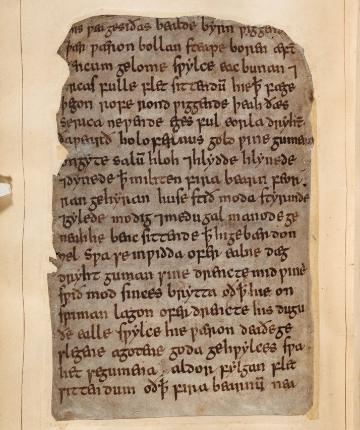
Judith
The poem is found in the same manuscript as Beowulf. It describes the beheading of the Assyrian general Holofernes in the Apocrypha. The poem is incomplete. Like Beowulf, it describes an heroic tale of heroism over evil. Modern scholars attribute authorship to Cynewulf
IX
She did not doubt the gifts of the honoured Creator
Of the wide Earth, from whence she had found succour
In her direst need. For the glorious godhead
Had protected her mortal soul,
And the Father in Heaven had granted her petition 5
Because her faith in Him was strong.
I have heard that the fearsome Holofernes
Gave a eager invitation to present
Wine and fine food at a great feast. The war-lord
Called on his thanes who came in haste; 10
A fine battalion of men made it to the prince.
They came upon him on the fourth day
Since Judith, bright and fair,
Guileful in mind, had first sought him
X
Then they sat at the benches to feast, 15
Comrades, warriors, mail-shirted soldiers,
Boastful in their cups. Along the ranks of men,
Flagons were carried, goblets stayed charged
And bowls kept full. Those ill-fated men
Drank their own doom, though their wicked ruler 20
Could have never foreseen it. Holofernes was
A broad and hearty host, he laughed
And shouted loudly, carousing in his cups,
So that men might hear his outpourings from afar,
His staunch oaths and belly-roared affirmations. 25
Drunken and obstinate, he preached earnestly
That his hall-men shouldn't be grave and solemn.
So it was that over the day, that terrible man
Drove on the men to get drunk on the mead,
Until they lost control of their own reason, 30
Whence they lay in a stupor, woozy and beaten,
Drained of all faculties. So he ordered
His men to attend until twilight.
Then, the corrupt man; he so full of sin,
Ordered that they should bring the blessed maid 35
Adorned with garlands and rings
Most richly to his chamber.
They did their duty as the prince had bid them,
They went post-haste to the guest-room
Where they came upon the most beautiful maiden, 40
Judith, wise and fair. From there they lead her
To the captain's lofty tent, where they found him,
Resting where he lay each night,
As was his habit and custom.
There was a golden-threaded 45
Fly-net of great beauty around the warrior's bed,
So that the hateful man might see through it
Any of his kins-men who came to seek him there
As they approached their chieftain.
But not a single man could have an audience 50
Unless that proud man had summoned them,
Or had commanded them into his sanctum,
Closer to him for counsel.
So they brought the woman to his bed,
The wise and fair lady, then they approached their lord 55
And told him that the holy woman
Was waiting for him in his tent. The notorious prince
Was overcome with delight when he thought of her,
That bright and rare creature about to be defiled
With impunity and disgrace by a wicked abuser. 60
But the Lord Almighty would not allow such perversion,
So he, the Holy Ruler of the World suppressed him.
That lasivious man, wanton and monstrous
Hurried forth to where he would soon meet his end;
A denoument for which he had always deserved, 65
That terrible prince, while he lived on the earth,
Beneath the heaven-tree of stars.
So he fell drunk onto his bed, insensible to pain and care.
His warrior-band, still merry on the mead
Left the tent and went quickly on their way; 70
That troop of soldiers had lad the oath-breaker,
Their malicious oppressor and prince of man
To his bed for the final time. Judith was mindful,
She who had served the Lord most strenuously,
Of how she might most readily attempt 75
To rip old age from the awful lord,
To wrench away a long life from the dark harrower
Before he awoke. Then that wise young girl
With flaxen hair sought out a keen blade-edge
To wield heavy blows and drew it out of its sheath. 80
Then she did call on the Creator of Heaven,
The Spirit of Truth and Saviour of the World, saying:
'I pray to you, O Lord of Creation,
Holy Son of the Father and Spirit of Hope,
To grant me mercy in my greatest need. 85
I am troubled with woe, for truly
My soul is on fire and my mind is desolate.
Lord of Heaven, grant me
Victory and a sure faith, that I might take this blade
And repay this fiend for his atrocities. 90
Give me my life, O Father
When I am in the greatest need of your great mercy,
Give me retribution, O God, give me a furious heart
And hot fire in my belly.' So it was that God
Filled her with boldness, as he does to all 95
Who seek his help with faith and hope.
Her heart was let loose to perform God's will,
She grabbed that dreadful man by his hair
And dragged him towards her. Drawing him closer,
She wrestled with him for a time, 100
Her trust in God set her strength and heart free
Until she had him under her control.
Then, she wielded the sword and struck him;
His own trusty weapon cleaving its master,
So that it cut halfway into his exposed neck. 105
He fell to the floor, dizzy, breathing softly,
Both drunk and terribly wounded. He clung onto life
But he lay still and stiff. Then the bold lady
Struck down again on the hated prince
And severed his head from his shoulders 110
So that it rolled away on the floor below.
The body, divorced from its crown lay still.
Then his vengeful soul swam in purgatory, raked with pain.
His spirit drifted in the nether-world
And was bound in torment below the earth, 115
Feasted on by giant snakes and serpents,
Tortured by the damned and facing eternal hell-fire.
He couldn't hope to ever escape
The hot sulphur choked that him,
He would forever endure the burning furnace 120
Of the foul devil's hall. He was doomed to be trapped there,
Evermore to remain at the mercy of monsters
In that terrible place, in the most profound anguish.
XI
Then wise Judith earned renown for her courage in the fight
As was given by God. She placed the dead man's head, 125
So bloody and gored into a bag
In which her fair-skinned maid
Had brought baked bread for them both.
She securely wrapped up the head in the sack
Then gave that gory prize to the girl. 130
Judith called on the young girl
To take it home. Then they both hurried out
From that place with bold and daring hearts.
Those glorious young girls went forth
Away from their safe home until they came upon 135
Bethulia's luminous walls. They approached,
Those radiant maidens, and followed the path
Away from the slumbering Assyrian troops
Until they came joyfully upon the castle-gate.
A group of war-men sat there, alert and awake. 140
She had commanded the baleful folk
To keep watch when Judith, the wise servant of God,
Cunning widow and brave soul
Travelled from that Hebrew tribe on her quest.
When she, that most beloved, 145
Returned to her tribe, that most prudent woman
Ordered one of the men to quickly go out to her,
Urgently, away from the city.
Immediately, they made him hurry back,
In haste, through the castle's portcullis 150
To deliver wise words to the gathered hoard. He said:
'I give you news of the greatest urgency,
News deserving of thanks and praise.
You no longer need to be sorrowful or mourn in your hearts
God is merciful! It shall be known 155
Over the whole wide earth that you have a renewed future.
It is bright and optimistic; a great redemption is conferred upon you,
For all the evil you have for too long experienced.'
The people felt the first stirrings of joy,
When they learned of how Judith had spoken 160
From beyond the ramparts. They became eager
And made for the great heavy gate;
A great surge of humanity
Moving like a single body, many thousand souls
Pressing forward, ushering towards Judith. 165
Young and old, every one of them
Fed off a growing mood of joyfulness
When they learned that she had returned
To her home. They greeted her with great happiness
When at last she processed through the gate. 170
Then Judith, made up with gold
Commanded her maid to take out Holfrernes' blood-caked head.
Her wise lady in waiting took up the head
And Judith held it aloft like a trophy; a horrible sight.
God had protected her and had granted the victory. 175
That noble and renowned lady said:
'Look, you people, high leaders and all the host,
Gaze upon this lifeless sign;
The head of a most despised and hated man,
This heathen, Holofernes who troubled us for so long 180
More than anyone before, under whom we suffered terrible torment,
And sorrows. He would have continued to do so,
But God didn't grant him life in his twilight years.
He was a terrible and hostile man who hated us.
He was loathsome, but I deprived him of that long life 185
With God's help. Now I must ask
Each of you men, every bold soldier-at-arms
To form your battalions and be ready
To fight the Assyrians, for soon our Father,
The great and holy God, will send the warm glow of dawn 190
In the east. So then, to your shields!
Wear them bravely, put mail on your breast
And burnished helmets on your heads,
So you may stand strong in the enemies' battle-ground.
Cut down their chiefs with your sharp-bright swords. 195
For God has condemned them; they will fall,
And you will gain fame which will live on forever!
The great God has showed me through my own hands!
The warriors prepared the ground,
They were ready for the fight, courage welled up in their breasts 200
And they set out, at sunrise, their war banners held aloft,
Marching towards the enemies camp-ground,
Heroes all under their bright-strong helmets.
Their shields reverberated
With a noise to wake the dead, As it should, the lean wolf 205
Howled in the forest and the hungry raven
Rattled its cry. Both animals knew the thick edge of battle
And also that soon, the warriors would provide them with carrion
For them to gorge on. Following behind them
The eagle, dewy-feathered, soaring on the wing, ready for scraps, 210
All dark-hued and horned-beaked sang out
A mournful song. So the soldiers moved ahead;
Heroes in the fight gathered behind bright-edged shields,
Hollow and rounded, they who had felt
And endured the enemies' reproach 215
And the wrath of the pagans. They had avenged them
By dealing out severe justice in the spear-battle,
As well as the Assyrians after the Hebrews closed in,
Under their war-banner to boldly storm their camp.
So the folk let fly a rain of arrows, 220
Bright flashes shot from the horn-bows,
Sturdy arrows, Grim harbingers of war.
They shouted with a blood-boiling cry, threw their spears
So they blackened the sky. They were angry,
Those battle-weary men, with the hated race. 225
The bloody-minded men moved forward, those brave men
Awakened their ancient foes from slumber,
Still drunk on mead. The men drew their bright-swords
From their sheaths and approached,
The keenest and choicest of blade-edges. 230
Then the hostile men, Assyrian warriors
Struck without mercy. No man was spared,
Neither the high or low caste
Of all men alive. They subdued them all.
XII
So the faithful drove on at the strangers, 235
Time and again in the morning-hours,
Thus the officers in the enemy camp tasted
The intensity of the sword-war
Perpetrated against them
By the merciless attack of the Hebrew warriors. 240
Their most noted soldiers drew up to the chieftain
And awoke the warriors in fear,
Told terrible tales and most dreadful news
To the still-woozy men, reports of terror
And blood-thristy sword-play. Then, so I've heard, 245
Those fated to die were aroused from sleep,
They stood and shook their woolly heads,
And turned towards the leaders' tent,
Pressing on through the throng, saddened and baleful,
To Holofernes. They had hoped to inform him 250
Of the state of the battle, before he was assaulted,
Before the Hebrews overcame him in their fury.
Every man thought he lay with his lady,
Under the fly-net in the high and noble tent,
Where he slept soundly on a comfortable bed; 255
The beautiful Judith and the perverted man,
Dreadful and fierce. Not a single soldier
Dared to wake up the tyrant,
Or seek out in the new day
Holofernes and that beautiful, godly virgin, 260
That delightful Servant of God.
The soldiers edged nearer,
The Hebrews carried on in their slaughter
With their finely-forged weapons. Their swords fell
Heavily on their mortal enemy,
Old insults were repaid. The Assyrians' war-might 265
Diminished that fateful day and their pride was disparaged.
Soldiers stood stunned around their prince's tent,
Grim-faced and angry, their minds in a spin.
Then, in unison, they cried out;
A terrible, anguished wail, lacking all grace, 270
Knawing and angry. They ground their teeth in anguish,
Their glory had died, all honour gone.
Those fighters had wanted to awaken their lord,
But he couldn't comfort them, no help was forthcoming.
Then, bravely one of the fighters stood 275
And dared to enter the tent, as was necessary.
He found his warrior-lord lying pale on the bolsters;
The grim and gored remains of a man
Whose life was now forfeit. Then he fell,
Mournful on the ground. 280
He grasped the matted hair, and also his tunic.
He was sorely troubled.
Then he spoke to the assembled soldiers
Waiting outside the unfortunate mans' tent
'This is the symbol of our own demise, 285
The awful token of our fate now realised.
Grief is piled on grief, and we have become worthless,
Doomed to live in strife, and then perish. Here, branded by the sword
Lies our departed king.' Then, sorrowfully,
They hastily departed, with dark hearts. 290
They let their swords fall. Then that mighty band of brothers
Followed on behind, until the majority of the host
Layed hewed down by the Hebrews
On that field of woe, brought down by the keenest edges,
Now the spoils for wolves, and carrion 295
For the blackened ravens. Then the remaining men fled;
The Hebrew warriors pursued them with shields.
They were most worthy of honour and praise;
A newly forged fame as great and noble warriors. Almighty God,
The Highest Lord had fought for them. 300
So, with decorated swords, those most courageous fighters,
Stout heroes thrashed through a straight path-way
Through a hostile enemy, hewed their bucklers
And broke through the shield-wall. Brave and strong,
They had become rage-hard in the fight. The Hebrews' 305
Mighty battalions, were eager to meet in
Desperate war-play. The best part of the Assyrians
Fell into the dust that day, that hostile army
Was scythed down like wheat.
Few came back home alive to their kin-folk. 310
The nobles turned away from the troops,
Warriors fell back into the wasteland
Among the stench of the carnage.
The Hebrews looted their lifeless corpses;
Took much bloody plunder, 315
Mail-shirts, bright shields and broad-swords,
Burnished helmets and treasure-hoards.
They had won a marvellous victory,
A glorious and fated conquest against the foe,
Their guards-men had slew with swords 320
They had overcome them and killed them where they stood,
That host of man once so feared, the most hostile
In the earth. Then all of God's people,
This special race, twisted-locked,
Over the course of a whole month, 325
Carried back to brightest Bethulia
Helmets and short-swords, hoary bymies,
War-treasure, gold decorations
And intricate ornaments of great artfulness.
Any of those brave men might say, 330
Any of those great fighters who had pressed their force,
Brave under the war-banner on the field of battle
That they had gained their advantage because of Judith,
Through her wise advice and courage. So they brought to her
A reward for her service; the sword and helmet 335
Of cruel Holofernes, soaked in his blood.
Likewise his mail-shirt of gold
And all that that wicked man had owned,
His princely goods and his inheritance.
Neck-bands and jewelry were handed to her, 340
That quick-witted and beautiful lady.
She said that God had bestowed the blessing
As a reward to her in the earth-life
And to multiply the His glory. This she truly believed
Of her dearest Lord in Heaven. She was resolute 345
In what she yearned for most fully;
To fight in the name of the Lord, who had made the world,
And the heavens, likewise the rivers
And all the joys of heaven, through his own omnipotent grace.
